
Senior Dentist & Full Mouth Rehabilitation Expert
One of the most common concerns among patients considering Full Mouth Dental Implants is how long recovery will take and when they can return to eating, speaking, working, and enjoying everyday life. The good news is that modern advancements in implant dentistry have significantly reduced recovery times compared to traditional treatment approaches. While mild swelling, tenderness, and discomfort are normal during the first few days after surgery, most patients are pleasantly surprised by how quickly they recover. In many cases, patients are able to resume routine daily activities within a few days and return to their normal lifestyle in less than a week.
For patients treated using the CPBCCI Protocol (Crestal Polished Bicortical Conventional Implants), recovery can be particularly efficient because the treatment is designed to utilize strong cortical bone and achieve excellent primary stability. Unlike traditional implant approaches that frequently involve additional surgical procedures such as bone grafting, sinus lift surgery, ridge augmentation, or prolonged healing periods, the CPBCCI Protocol often allows treatment to be completed using available native bone. By avoiding multiple invasive procedures, patients typically experience less surgical trauma, reduced treatment time, fewer appointments, and a faster return to normal life.
One of the most significant advantages of the CPBCCI Protocol is its ability to support Immediate Loading Dental Implants, allowing
Patients to receive fixed teeth shortly after implant placement. Rather than spending months, waiting for implants to heal before receiving teeth, suitable candidates can often walk away with fixed teeth within days.
This immediate restoration of function and aesthetics has transformed the patient experience and has become one of the most sought after advancements in modern implant dentistry.
Recovery after full mouth implant surgery occurs in two phases. The first phase involves healing of the gums and surrounding soft tissues. This initial recovery period generally lasts one to two weeks. During this time, any swelling gradually subsides, the surgical sites begin healing, and patients become increasingly comfortable with their new teeth.
The second phase involves a biological process known as OsseoIntegration, during which the implants form a stable connection with the surrounding bone. Although this process continues beneath the surface for several months, patients undergoing immediate loading protocols can often enjoy the benefits of fixed teeth long before complete OsseoIntegration is achieved.
The ability to provide immediate function while healing continues is one of the reasons why modern implant protocols have become so popular among patients seeking a faster and more convenient solution to tooth loss.
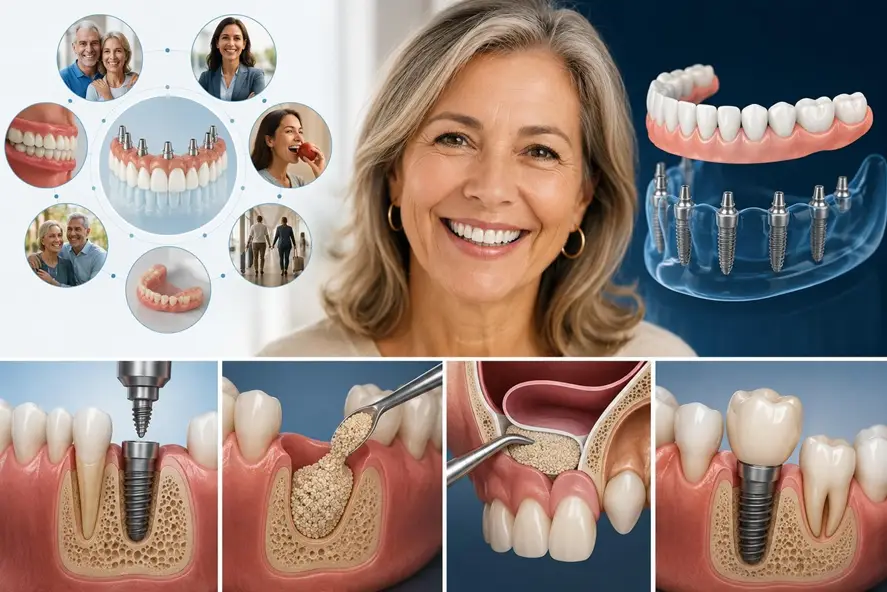
Immediate loading has fundamentally changed the way full mouth implant rehabilitation is performed.
Some of the most important benefits include: Fixed teeth immediately after implant placement No prolonged period without teeth
Faster return to work and social activities Improved confidence and appearance immediate restoration of chewing function
Reduced dependence on removable dentures Fewer treatment stages
Improved patient comfort and convenience
Enhanced quality of life from the very beginning of treatment
For many patients, the emotional benefits are just as significant as the physical benefits. The ability to smile confidently immediately after treatment often has a profound impact on self-esteem and social interactions.
Traditional implant treatments frequently require patients to undergo multiple procedures before implants can even be placed. These may include dental bone grafting, sinus augmentation, and lengthy healing periods that can extend treatment over several months or even years.
By utilizing strong cortical bone and advanced treatment planning principles, many patients can avoid extensive grafting procedures. This not only reduces treatment complexity but also minimizes post-operative discomfort and accelerates recovery.
For patients who have been told they have insufficient bone for conventional implants, the CPBCCI Protocol may provide an alternative treatment pathway that enables them to receive fixed teeth without undergoing multiple surgical interventions.
The result is a more streamlined treatment experience, fewer procedures, shorter overall treatment times, and a faster return to normal daily activities.
Immediately after surgery, patients may experience mild swelling, tenderness, and temporary discomfort. These symptoms are generally well managed with prescribed medications.
During this period:
Adequate hydration is encouraged. Rest is recommended.
Soft foods are preferred.
Most patients remain comfortable at home.
Many patients report significantly less discomfort than they initially anticipated.
By the end of the first week:
Swelling is substantially reduced. Speech becomes more comfortable.
Confidence increases significantly as permanent teeth will be fixed. Most patients return to work and routine daily activities.
Patients who receive immediate loaded fixed teeth often experience a dramatic improvement in quality of life during this period.
Patients adapt further to their fixed teeth.
Follow-up appointments help monitor healing progress.
One of the most common questions patients ask is whether they will be able to eat normally after surgery.
Unlike traditional approaches where patients may spend months adapting to removable dentures, immediate loading protocols allow patients to begin using their fixed teeth immediately in less than a week.
Initially,during the first 3 days after surgery, softer foods are recommended, including:
Yogurt, Soups,Smoothies,Scrambled eggs,Soft rice,Mashed vegetables,Pasta and Fish
As healing progresses, patients gradually return to a broader diet.
Many patients treated with the CPBCCI Protocol find themselves enjoying many of their favorite foods within a remarkably short period of time. This rapid return of chewing function is one of the most appreciated benefits of immediate loading.
Several factors affect how quickly a patient heals: Bone quality and density
Expertise of the performing surgeon Overall health condition
Smoking habits
Oral hygiene practices
Compliance with post-operative instructions Surgical complexity
Implant stability achieved during placement
Patients who maintain good oral hygiene and carefully follow professional instructions generally experience smoother and more predictable recovery.
Several factors affect how quickly a patient heals: Bone quality and density
Expertise of the performing surgeon Overall health condition
Smoking habits
Oral hygiene practices
Compliance with post-operative instructions Surgical complexity
Implant stability achieved during placement
Patients who maintain good oral hygiene and carefully follow professional instructions generally experience smoother and more predictable recovery.
The following symptoms are usually part of normal healing:
Mild swelling,Minor bruising,Temporary tenderness,Temporary speech adaptation
Patients should contact their implant team if they experience: Persistent bleeding
Severe pain Fever
Increasing swelling after several days Implant mobility
Fortunately, complications are uncommon when treatment is carefully planned and executed.
While complete bone healing occurs over several months, most patients return to normal daily activities within days rather than months.
Most patients describe the procedure as far more comfortable than expected, especially when compared to living with failing teeth or unstable dentures.
Immediate loading protocols often allow patients to regain chewing function much sooner than traditional treatment methods.
Age is rarely a limiting factor for dental implant treatment. Most adults over the age of 18 with missing teeth can be considered for implants. Advances in implant dentistry now allow successful rehabilitation of many patients who have severe bone loss, diabetes, or smoking habits, conditions that were once considered major obstacles to treatment. However, a comprehensive clinical evaluation is essential to determine the most suitable treatment plan.
The quality of recovery depends heavily on proper treatment planning and execution.
Successful outcomes require:
Accurate diagnosis Advanced CBCT imaging Appropriate implant selection Precise implant positioning Well-designed prosthetics
Comprehensive post-operative care
The experience and expertise of the treating team often play a major role in determining long-term success.
The recovery period after Full Mouth Dental Implant Surgery is far shorter and more comfortable than many patients expect. Thanks to modern advancements such as the CPBCCI Protocol and Immediate Loading Dental Implants, many patients can avoid additional invasive procedures like bone grafts and sinus lifts, receive fixed teeth within days, and return to their normal routine in less than a week.
Rather than spending months coping with removable dentures or waiting for treatment to progress through multiple stages, suitable candidates can enjoy the benefits of Permanent Fixed Teeth, improved chewing ability, enhanced confidence, and a dramatically improved quality of life almost immediately.
For individuals struggling with missing teeth, loose dentures, failing dental work, or severe bone loss, modern immediate loading protocols represent one of the most significant advances in implant dentistry. When properly planned and executed, they provide a predictable, efficient, and life-changing pathway to restoring both oral function and confidence for years to come.
Many practitioners continue recommending bone grafts because they are trained in traditional placement of conventional implants and may not be skilled in advanced techniques like Zygomatic implants or Pterygoid implants and Tilted implant technique with CPBCCI Protocol which helps place implants in resorbed jaw bones without subjecting the patient to invasive and time consuming surgeries like sinus lifts and bone grafts and also immediate loading of permanent teeth in less than a week. Additionally, grafting increases treatment duration and cost. However, centers like LBR Dental & Implant Center use modern protocols that eliminate grafting while improving success rates, especially in complex
Zygomatic implants are anchored in the dense cheekbone (zygoma), which is highly mineralised, not affected by infections like pericoronitis and does not resorb like jawbone. These implants are ideal for patients with extreme bone loss where placement of implants in the jaw bone is not possible due to low bone volume or poor quality of the jaw bone. At LBR, Dr. K. A. Reddy performs free-hand precision Zygomatic implant surgery under local anaesthesia, enabling immediate loading with fixed teeth,without any grafting procedures.
The CPBCCI protocol focuses on bicortical anchorage and Tilted implants, engaging strong cortical bone layers for maximum stability. This allows immediate loading, reduces infection risk, and ensures long-term durability. It is especially beneficial for diabetic patients, smokers, and those with compromised bone conditions, making it one of the most advanced implant techniques available today.
Dr. Reddy is widely recognized for his ability to treat highly complex implant cases that are often rejected elsewhere. His expertise in quad zygomatic implants, pterygoid implants, nerve bypass technique and immediate full mouth rehabilitation has transformed thousands of lives. His precision, experience, and commitment to graftless dentistry position him among the top dental implant surgeons in India for full mouth restoration.
Absolutely. India has become a global hub for advanced dental tourism, and centers like LBR Dental & Implant Center offer world-class treatment at a fraction of international costs. Patients benefit from FDA-approved implant systems, internationally aligned sterilization protocols, and immediate results, making it a trusted destination for full mouth rehabilitation.


Senior Dentist & Full Mouth Rehabilitation Expert