
Senior Dentist & Full Mouth Rehabilitation Expert
One of the first questions patients ask during a consultation for full mouth dental implants is:
The answer is not the same for everyone. Some patients can have a complete arch of fixed teeth supported by as few as four implants, while others may require six or eight implants to achieve the best long-term result. The exact number depends on several factors, including the amount of available bone, jaw anatomy, bite forces, and the type of final teeth being planned.
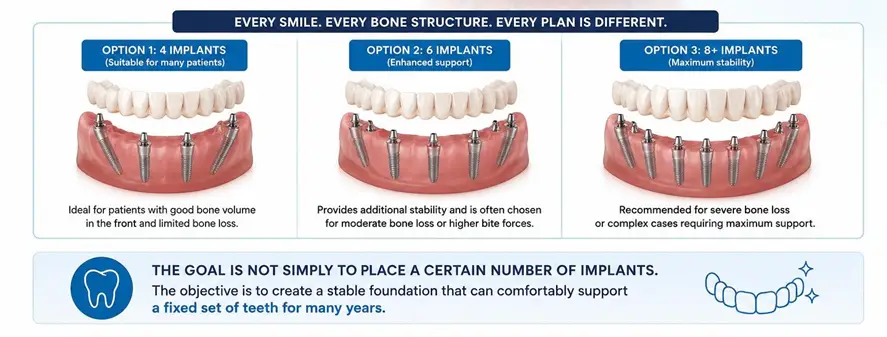
Many people searching online come across terms such as “All-on-4,” “Full Arch Dental Implants,” or “Fixed Teeth in 3 Days” and assume that every patient receives the same number of implants. In reality, successful full mouth rehabilitation is highly individualized. The goal is not simply to place a certain number of implants. The objective is to create a stable foundation that can comfortably support a fixed set of teeth for many years.
Every mouth is different. A patient who has recently lost teeth due to decay may have excellent bone volume and density, allowing fewer implants to adequately support the prosthesis. On the other hand, someone who has been without teeth for many years may have experienced significant bone loss and may benefit from additional implant support. Patients who have strong chewing muscles, a history of teeth grinding, or wider jaw arches may also require more implants to distribute forces effectively.
For the lower jaw, most full arch restorations are supported by four to six implants. For the upper jaw, where bone is generally softer, six to eight implants are commonly recommended. When both upper and lower arches are being restored, the total number of implants often ranges between eight and sixteen. These numbers are only general guidelines. A detailed clinical examination and CBCT scan are necessary before a definitive treatment plan can be created.
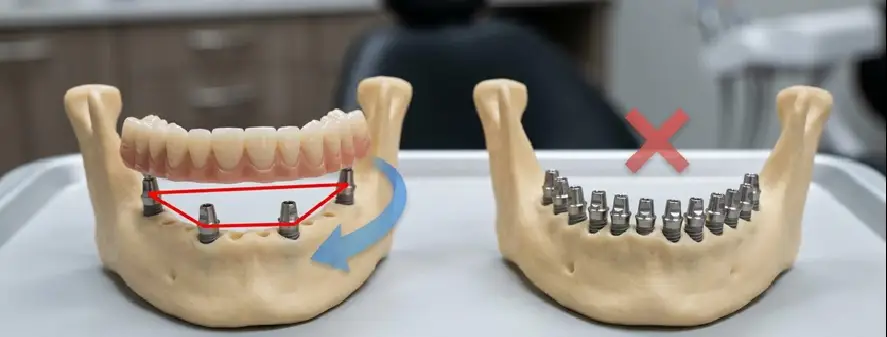
Not necessarily. One of the biggest misconceptions in implant dentistry is that placing more implants automatically leads to superior outcomes. In reality, long-term success depends far more on meticulous treatment planning, precise implant positioning, prosthetic design, biomechanical considerations, and ongoing maintenance than on the number of implants alone.
A carefully planned All-on-6 rehabilitation can often outperform a poorly designed treatment involving a larger number of implants. As the name suggests, the All-on-6 concept utilizes six implants in each jaw, strategically distributed throughout the length of the arch to maximize support and load distribution.
In the upper jaw, the posterior implants are anchored into the dense pterygoid bone located behind the upper third molars, while in the lower jaw, advanced nerve bypass techniques allow implant placement in the posterior-most regions without compromising vital anatomical structures. This approach enables optimal implant spread, eliminates or significantly reduces prosthetic cantilevers, improves stability, and enhances chewing efficiency.
When implants are placed in the right positions and integrated into a well-designed prosthesis, patients often achieve better functional and long-term results than they would with a greater number of implants placed without proper biomechanical planning.
Several important factors influence treatment planning:
The available bone is one of the most important considerations. Strong, healthy bone allows implants to achieve excellent stability.
Natural anatomical structures such as the maxillary sinus and mandibular nerve influence where implants can be safely placed.
The design of the final bridge also plays a role. A full arch zirconia restoration may require a different implant distribution compared to other prosthetic options.
Patients who generate higher chewing forces often benefit from additional support.
For patients seeking fixed teeth immediately after implant placement, achieving adequate implant stability is essential.
Many patients are surprised to learn that bone grafting is not always necessary. Modern implant protocols often allow implants to be placed in available native bone, avoiding extensive grafting procedures in suitable cases. The decision can only be made after proper imaging and evaluation.
Patients often focus on the number of implants required. A more important question is:
The answer depends on a thorough assessment of your oral health, bone condition, medical history, and treatment goals.
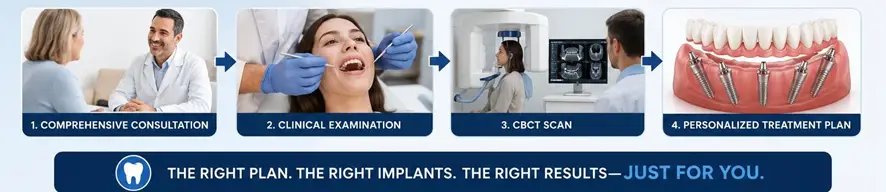
If you are considering full mouth dental implants, avoid comparing your case with someone else’s treatment. The ideal number of implants varies from patient to patient. What matters most is receiving a treatment plan that is designed around your individual needs rather than following a standard formula. A comprehensive consultation, clinical examination, and CBCT scan will determine the most appropriate implant configuration to provide stable, functional, and natural-looking teeth for years to come.
The number of dental implants required for full mouth teeth replacement varies from one patient to another. In most cases, a full arch of fixed teeth can be supported by 4 to 6 or 8 dental implants per jaw. Patients replacing both upper and lower teeth may require anywhere between 8 and 16 implants in total.
The ideal number depends on factors such as bone quality, bone volume, jaw size, bite forces, and the design of the final prosthesis. A CBCT scan and clinical examination are essential to determine the most suitable treatment plan.
Yes, in selected cases, a complete arch of teeth can be supported by four strategically placed implants. However, not every patient is an ideal candidate for a All on 4 solution. Patients with good bone density, favorable jaw anatomy, and moderate chewing forces may qualify. In other situations, additional implants may be recommended to provide better load distribution and long-term stability. The decision should always be based on clinical findings rather than a predetermined number.
Additional implants may be recommended when:
The objective is to create a strong and balanced foundation that can withstand years of daily function.
Not necessarily. Many people assume that more implants automatically lead to better outcomes, but successful implant treatment depends on proper planning, implant positioning, surgical precision, prosthetic design, and long-term maintenance. A well-designed restoration supported by six strategically placed implants may outperform a poorly planned restoration supported by a greater number of implants.
Quality of treatment planning is more important than quantity alone.
Several factors influence treatment planning, including:
Modern CBCT imaging allows the implant team to evaluate bone in three dimensions and determine the most appropriate implant configuration.
yes, in a full arch or a full mouth rehabilitation, the existing damaged teeth will be removed and implant placed immediately This approach may reduce overall treatment time and can allow patients to receive fixed teeth immediately.
However, in sectional replacement cases which require placement of less than 2 implants may not be suitable for immediate teeth placement. The final decision depends on the condition of the bone and surrounding tissues.
No. Many patients are concerned that they will need extensive bone grafting before implant treatment. Fortunately, this is not always necessary. Advances in implant planning and surgical techniques often allow implants to be placed in available native bone. Whether grafting is needed can only be determined after a detailed clinical assessment and CBCT scan.
Even patients with significant bone loss may still be candidates for full mouth dental implants.
Depending on the clinical situation, treatment options may include, placement of pterygoid implants and Zygomatic implants in the upper arch and nerve bypass technique in the lower jaw without subjecting the patient to
A comprehensive evaluation helps determine the most predictable approach for each patient.
One of the biggest advantages of modern full mouth dental implant treatment is that patients do not have to wait months without teeth.
Using the Immediate Loading Technique, dental implants are placed and a fixed set of teeth is attached within a week in most cases, allowing patients to leave with a functional smile almost immediately.
For patients with severe bone loss who are often told they are not suitable for conventional implants, advanced solutions such as Zygomatic Implants and Pterygoid Implants can eliminate the need for bone grafting and sinus lift procedures. These specialized implants are anchored in stronger areas of the facial bone and are also loaded immediately with fixed teeth, providing a predictable and long-lasting solution even in complex cases.
At ATLBR Dental & Implant Center, most international patients complete their treatment within 7 to 10 days, including:
This means patients can regain their smile, confidence, speech, and chewing ability in a single visit without prolonged waiting periods, removable dentures, bone grafts, or sinus lift surgeries.
Most patients are surprised by how comfortable the procedure is.
Implant surgery is performed under local anesthesia, and sedation options may be available when appropriate. Post-operative discomfort is usually manageable with prescribed medications and tends to improve significantly within a few days.
Many patients report that the experience was easier than they expected.
Dental implants are designed as a long-term solution for tooth loss.
With proper oral hygiene, regular professional maintenance, and periodic reviews, implants can function successfully for many years. While the implants themselves can last for decades, the prosthetic components may occasionally require maintenance or replacement over time.
Long-term success also depends on lifestyle factors such as smoking, oral hygiene practices, and general health.
Age alone is not a limiting factor.
Many patients in their 60s, 70s, and even 80s successfully undergo implant treatment. What matters more than age is overall health, bone condition, and the ability to heal normally.
A comprehensive medical and dental evaluation helps determine suitability for treatment.
Many diabetic patients can successfully receive dental implants and get teeth immediately loaded on implants, using the CPBCCI Protocol.
Fixed implant-supported teeth offer several advantages:
Many patients describe fixed teeth as feeling significantly closer to natural teeth than removable dentures.
The most important factor is comprehensive treatment planning. Successful outcomes depend on accurate diagnosis, proper implant positioning, careful prosthetic design, surgical expertise, and long-term maintenance. Choosing an experienced implant team and undergoing a thorough evaluation are often more important than focusing solely on the number of implants being placed.


Senior Dentist & Full Mouth Rehabilitation Expert