
Senior Dentist & Full Mouth Rehabilitation Expert
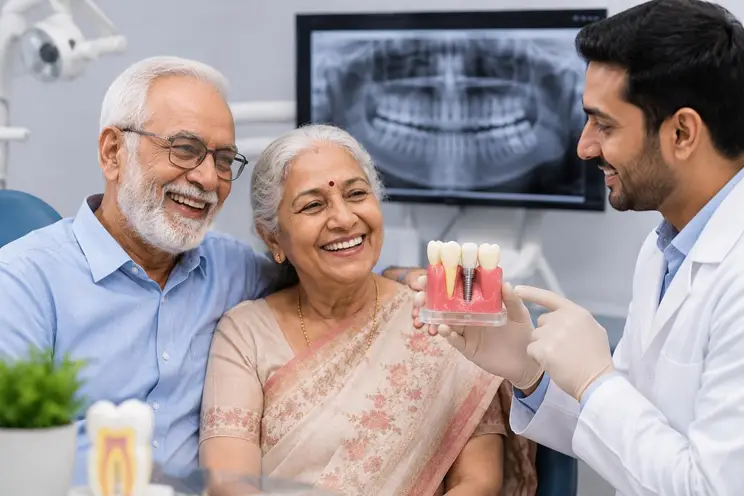
One of the most common questions asked by senior citizens is, “Am I too old for dental implants?” The answer is simple: No. Age is not a barrier to successful dental implant treatment. Modern implant dentistry has proven that overall health, proper diagnosis, experienced doctor with good expertise and treatment planning are far more important than chronological age. Every year, thousands of patients in their 60s, 70 and 80s, successfully receive dental implants and enjoy a renewed ability to eat, speak, and smile with confidence.
At LBR Dental & Implant Center, we frequently meet patients who believe that losing teeth is an inevitable part of aging and that removable dentures are their only option. Many have struggled for years with loose dentures, difficulty eating, speech problems, facial collapse, and a loss of self-confidence. Fortunately, advances in implantology have transformed the way tooth loss is treated. Today, dental implants provide a fixed, stable, and long-lasting solution that closely replicates the function and appearance of natural teeth.
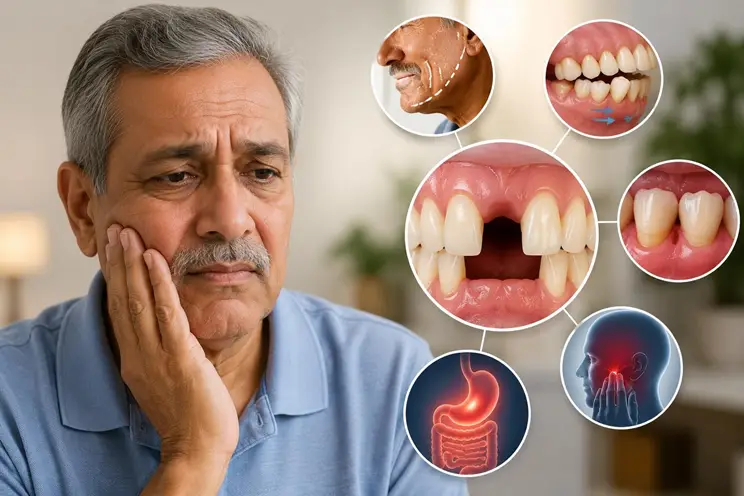
Tooth loss affects much more than appearance. Missing teeth can lead to progressive bone loss, reduced chewing efficiency,digestion related problems. nutritional deficiencies, speech difficulties, and deterioration of facial aesthetics. Many patients gradually begin avoiding social situations, smiling less, and restricting their diet because they are unable to chew comfortably.
The longer missing teeth remain untreated, the greater the amount of bone loss that can occur,this is because there is no stimulation to the jaw bone (due to the absence of natural tooth roots) that usually happens when natural teeth are existing,This is one of the primary reasons why many elderly patients are told they do not have sufficient bone for conventional dental implants. However, modern implantology has created solutions for even the most challenging situations.
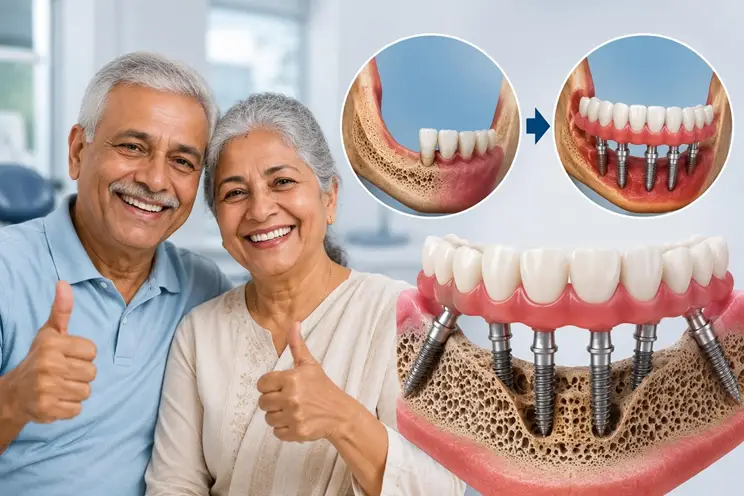
One of the biggest concerns among elderly patients is jawbone loss. Years of missing teeth, advanced periodontitis, and long-term denture use can result in significant bone resorption. Traditionally, patients with severe bone loss were often advised to undergo multiple additional surgical procedures such as sinus lifts, bone grafts, ridge augmentation, and other reconstructive surgeries before implant placement could be attempted.
While these procedures may be indicated in certain treatment philosophies, they are often invasive, increase treatment costs, require prolonged healing periods, and may delay the final restoration by several months.
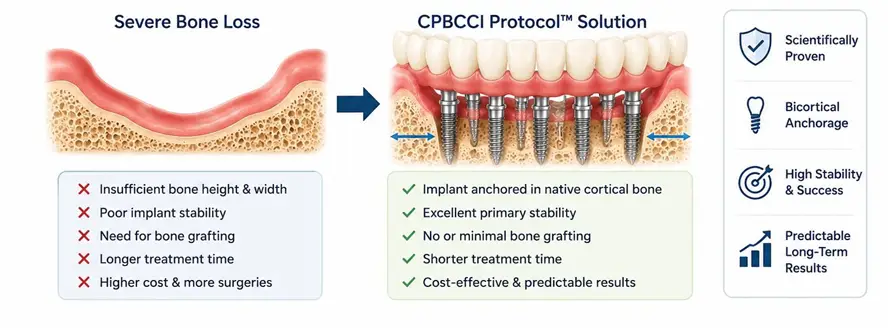
The CPBCCI Protocol™ (Crestal Polished Bicortical Conventional Implants), introduced by Dr. K. A. Reddy, has revolutionized the rehabilitation of patients with severe bone loss. This scientifically proven implant protocol is based on utilizing the available native cortical bone for implant anchorage rather than relying on extensive bone augmentation procedures.
A major advantage of the CPBCCI Protocol™ is that it often eliminates the need for invasive procedures such as sinus lifts and bone grafts in patients. By engaging stable bicortical bone, implants can be placed in the patient’s existing native bone regardless of the extent of bone loss, making treatment possible for many patients who have previously been told that implants were not an option.
This approach significantly reduces treatment time and allows patients to avoid multiple surgeries and prolonged healing periods. Instead of waiting months for graft maturation and bone healing, patients can often proceed directly to implant placement and fixed teeth rehabilitation.
One of the most exciting advantages of the CPBCCI Protocol™ is the ability to provide immediate functional rehabilitation, patients can receive fixed teeth shortly after implant placement, allowing them to return to normal daily activities much sooner than with conventional treatment approaches.
For patients who have suffered for years with loose teeth, failing dentition, or unstable dentures, immediate loading can be truly life-changing. The ability to eat, speak, and smile confidently again can dramatically improve overall quality of life.
Many patients assume that conditions such as diabetes or smoking automatically disqualify them from receiving dental implants. However, this is not always true.
The CPBCCI Protocol™ has demonstrated excellent clinical success in diabetic patients with uncontrolled blood sugar levels as well as in smokers. Through precise treatment planning, strong cortical bone engagement, and adherence to strict surgical principles, many patients who are traditionally considered higher-risk candidates can successfully undergo implant rehabilitation.
This has made advanced implant treatment accessible to a wider group of patients who may otherwise have been denied treatment under conventional protocols.
Successful implant treatment depends on several factors, including:
*Oral hygiene
*Accurate diagnosis and Treatment planning
*Surgical expertise of the implantologist
*Type of implants ( Basal implants or Conventional implants)
*Type of prosthesis( screw retained teeth or Cement retained teeth)
*Well-designed prosthetic rehabilitation.
When these factors are optimized, modern dental implants can achieve long-term success rates exceeding 95% over many years.A healthy 75-year-old patient may be a much better candidate for implant treatment than a younger patient with poor oral hygiene. For this reason, age alone should never determine whether someone can benefit from dental implants.
Patients who undergo full-mouth rehabilitation often report significant improvements in:
Chewing ability Proper digestion Speech clarity Facial support
Proper Nutritional intake Self-confidence
Social interactions Overall quality of life
Many patients describe receiving fixed teeth as one of the most transformative healthcare decisions they have ever made. Restoring the ability to smile confidently and eat comfortably can positively impact both physical and emotional well-being.
At LBR Dental & Implant Center, every patient receives a comprehensive evaluation that includes clinical examination, digital diagnostics, and CBCT imaging. Each treatment plan is customized to the patient’s unique needs and anatomical conditions.
Under the leadership of Dr. K. A. Reddy, the center has successfully rehabilitated thousands of patients suffering from severe periodontitis, advanced bone loss, and complete tooth loss. Through the scientifically proven CPBCCI Protocol™, patients who were previously considered unsuitable for implant treatment may now have an opportunity to regain fixed teeth and restore normal function.
You are rarely too old for dental implants. What truly matters is not your age but the expertise of the treating implantologist.
Modern advancements such as the CPBCCI Protocol™, pioneered by Dr. K. A. Reddy, have transformed the treatment of severe bone loss by utilizing available native bone, reducing the need for invasive procedures such as sinus lifts and bone grafts, shortening treatment times, and enabling immediate functional rehabilitation.
Whether you are 60, 70, 80, or beyond, dental implants may still be a viable option. With proper diagnosis, advanced treatment planning, and expert care, it is possible to regain fixed teeth, restore confidence, and enjoy a better quality of life regardless of age.
No. There is no upper age limit for dental implant treatment, while the lower age limit is 18 years,Dental implants can be placed irrespective of the amount of bone present,in highly resorbed jaw bone cases,upper jaw will be managed using Zygomatic implants and lower jaw will be managed using nerve bypass technique.
Yes. Many patients in their 80s and even 90s have successfully undergone implant placement and immediate fixed rehabilitation and continue to enjoy excellent function.
Severe bone loss does not automatically prevent implant treatment. The CPBCCI Protocol™ utilizes available native cortical bone, allowing treatment in many cases that would traditionally require bone grafting.
Not necessarily. Many patients treated with the CPBCCI Protocol™ can avoid these additional procedures because the protocol focuses on utilizing existing native bone.
In many suitable cases, yes. Immediate implant placement and immediate loading may be possible depending on clinical conditions.
Yes. diabetic patients can undergo successful implant treatment using CPBCCI Protocol, where implants with polished collar and rough surface are placed in the crestal bone using the tilted implant technique.
Yes. While smoking remains a risk factor for oral health, many smokers have successfully undergone rehabilitation using advanced implant protocols like CPBCCI.
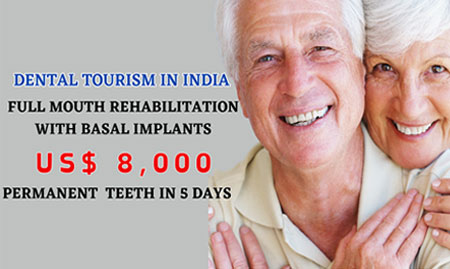
Traditional approaches involving grafting procedures may require several months. However, with the CPBCCI Protocol™, treatment times can be significantly reduced, and teeth immediate loaded. A single visit spanning around 10 days is what is required for a successful full mouth rehabilitation on implants.
With proper oral hygiene and regular maintenance, dental implants can provide long-term function and stability for many years.
A comprehensive consultation, CBCT scan, and clinical evaluation at LBR Dental & Implant Center can determine the most suitable treatment options based on your specific condition.


Senior Dentist & Full Mouth Rehabilitation Expert