

Dr. K Sharada Reddy, Author
Senior Dentist & Full Mouth Rehabilitation Expert
How Immediate Loading Dental Implants
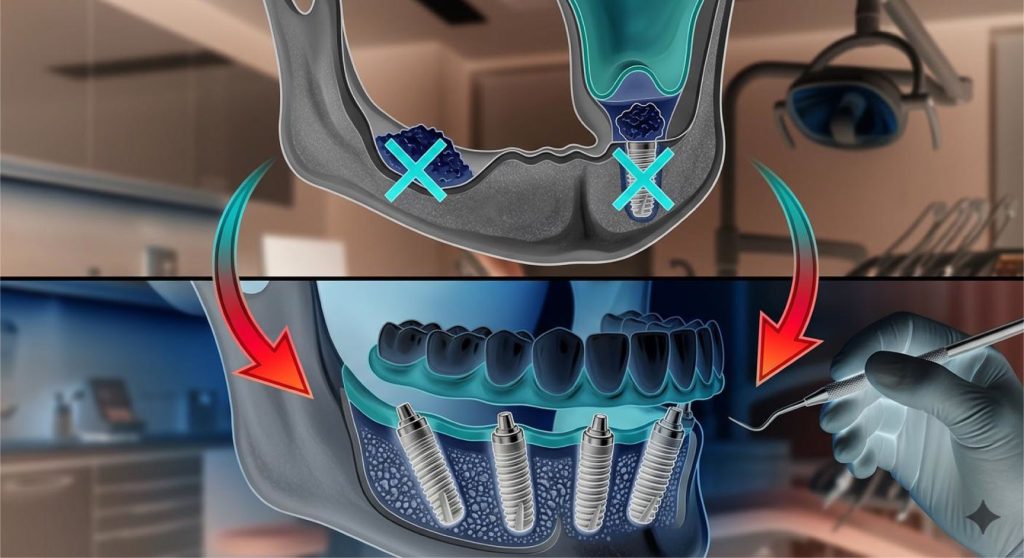
Patients with severe bone loss in the upper and lower jaw are often told that dental implants are not possible without bone grafting or sinus lift surgery. However, with modern advancements in implant dentistry, immediate loading dental implants in severe bone loss cases have become highly predictable and successful. Today, patients can receive full mouth dental implants without bone grafting, avoiding long treatment delays, multiple surgeries, and uncertain outcomes.
Severe bone loss commonly occurs due to long-standing infections around teeth, delayed tooth replacement after extraction, or advanced gum disease. When infected teeth are retained for long periods, the surrounding bone gets destroyed, leading to insufficient bone for implant placement. Similarly, when teeth are not replaced immediately after extraction, the maxillary sinus expands (sinus pneumatization) into the empty space, especially in the upper posterior (molar) region, resulting in reduced bone height. These factors make conventional implant placement difficult and are the primary reasons why many clinicians suggest sinus lifts and bone grafting procedures, which are often unpredictable, time consuming (6–12 months or more), and may or may not yield desired results
Why Avoid Bone Grafting and Sinus Lift Procedures?
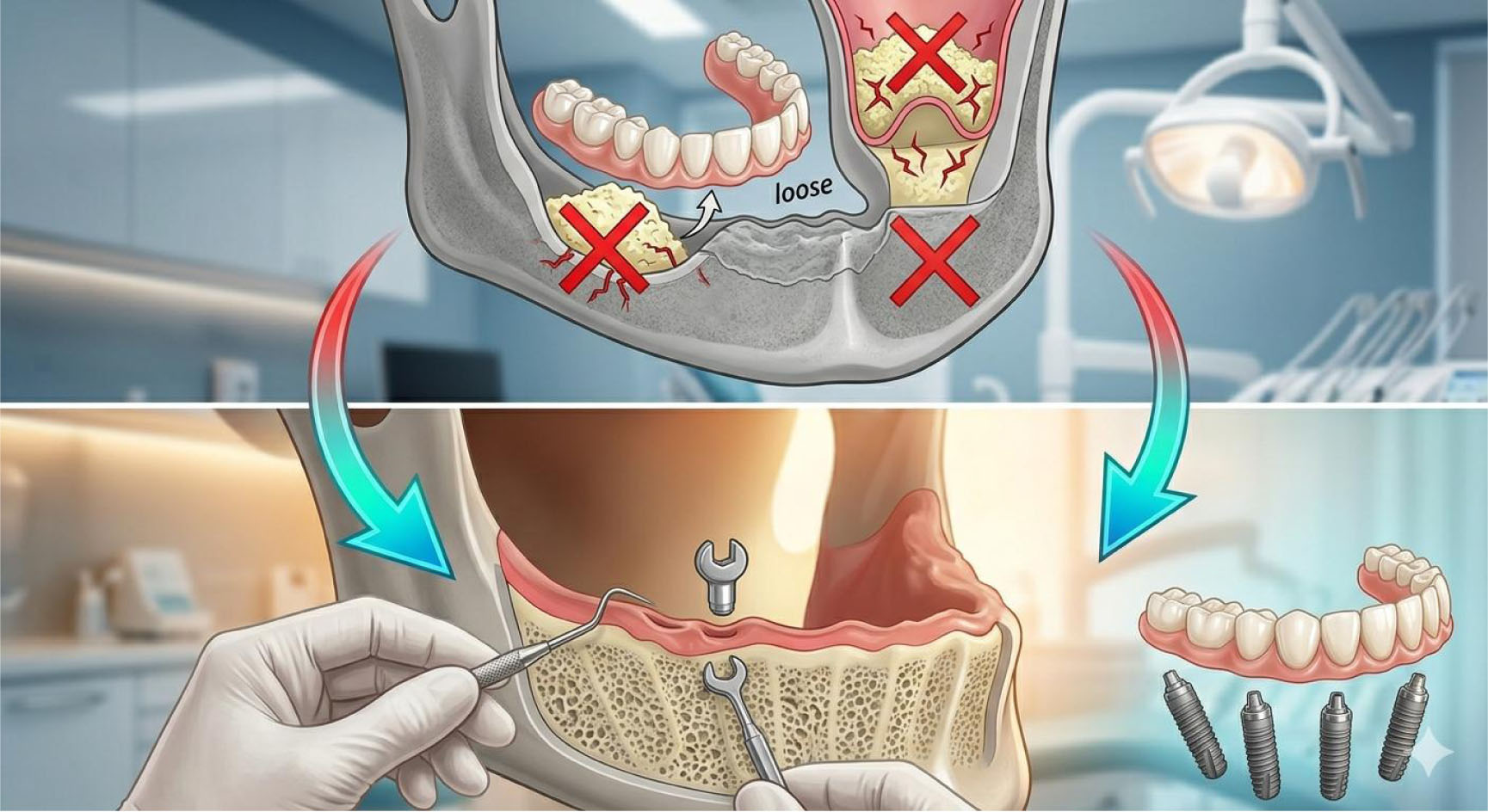
Traditional approaches like bone grafting and sinus lift surgery involve additional surgical sites, prolonged healing time, increased cost, and uncertain graft acceptance. Patients are often left with no teeth or temporary dentures, which may be uncomfortable and unstable during the healing phase. In many severe bone loss cases, even after grafting, the bone quality may not be sufficient for long-term implant success. This is why modern implantology focuses on graft-less implant techniques that utilize existing strong bone structures.
Traditional approaches like bone grafting and sinus lift surgery involve additional surgical sites, prolonged healing time, increased cost, and uncertain graft acceptance. Patients are often left with no teeth or temporary dentures, which may be uncomfortable and unstable during the healing phase. In many severe bone loss cases, even after grafting, the bone quality may not be sufficient for long-term implant success. This is why modern implantology focuses on graft-less implant techniques that utilize existing strong bone structures.
Immediate Loading Dental Implants: A Game-Changer
Immediate loading dental implants allow placement of fixed teeth within 48–72 hours, even in patients with compromised bone. This is achieved by engaging dense cortical (basal) bone, which remains stable despite bone loss. Advanced techniques such as tilted implants and bicortical engagement, as used in the CPBCCI (Crestal Polished Bicortical Conventional Implant) protocol, significantly improve implant-to-bone contact ratio, ensuring excellent primary stability and long-term success.
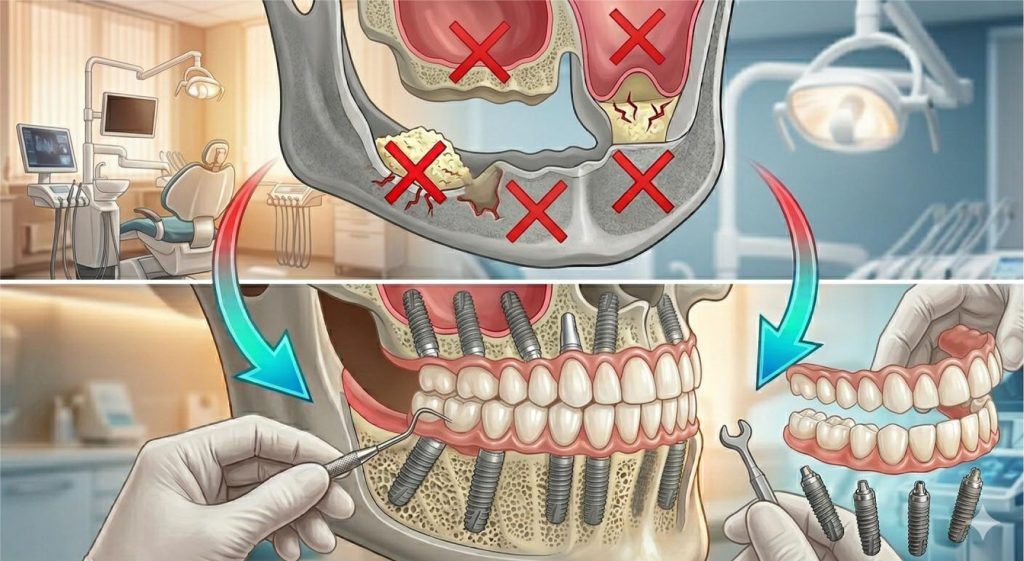
Unlike small or “mini implants,” conventional implants used in CPBCCI protocol are strategically placed in available strong bone, often at an angle, to maximize anchorage and load distribution. This allows for immediate functional loading, enabling patients to chew and
smile confidently within days.
Managing Severe Bone Loss in the Upper Jaw Without Bone Grafting
Bone deficiency in the upper jaw is most commonly seen in the posterior region (molars) due to the presence of the sinus cavity. In such cases, the commonly suggested All-on-4 dental implant technique places four implants in the anterior region (in front of the sinus) where bone is relatively better. However, this approach results in a cantilever prosthesis, where the back teeth (molars) lack direct implant support, even though they bear the maximum chewing forces.
Why Pterygoid Implants Are Essential
To overcome this limitation, pterygoid implants are placed in the pterygoid bone located behind the upper third molars. This bone is dense and provides excellent anchorage. Pterygoid implants extend support till the last replaced tooth, eliminating cantilever and ensuring proper load distribution across the arch. They play a critical role in immediate loading full mouth dental implants in the upper jaw, especially in severe bone loss cases.
Role of Zygomatic Implants in Extreme Bone Loss
In cases where even the anterior bone (in front of the sinus) is insufficient, zygomatic implants are used. These implants are anchored into the zygomatic (cheek) bone, which is strong and does not resorb. Depending on the severity of bone loss, one, two, three, or even four zygomatic implants(quad zygoma) may be placed. In extremely compromised cases, a combination of multiple zygomatic implants along with pterygoid implants can be used to support full mouth fixed teeth immediately, without any grafting.
Managing Severe Bone Loss in the Lower Jaw Without Bone Grafting
In the lower jaw, bone is usually adequate in the anterior region in about 90% of cases, but challenges arise in the posterior region due to the presence of the inferior alveolar nerve. Conventional approaches like All-on-4 avoid this nerve by placing implants only in the front, again leaving the molar region without direct implant support.
Nerve Bypass Technique: A Superior Solution
With advanced techniques such as the nerve bypass technique, implants can be placed in the posterior region by safely bypassing the nerve using available cortical bone. This allows placement of 6 implants in the lower jaw, ensuring full arch support including molars, and enabling immediate loading of fixed teeth without compromising safety.
CPBCCI Protocol: The Foundation of Advanced Implant Success
The CPBCCI (Crestal Polished Bicortical Conventional Implant) protocol, developed by Dr. K. A. Reddy, considered as the (best Zygomatic implant specialist in india), is a breakthrough in managing severe bone loss cases without bone grafting. This protocol utilizes tilted implant placement and bicortical anchorage to engage strong cortical bone layers, significantly improving implant stability. The polished implant surface reduces infection risk, while strategic placement ensures optimal load distribution. This approach avoids the drawbacks of traditional methods and provides long-term, predictable results with immediate loading capability, even in the most challenging cases.
This approach avoids the drawbacks of traditional methods and provides long-term, predictable results with immediate loading capability, even in the most challenging cases.
Why Basal Implants Are Not Preferred
Although basal implants are also used for immediate loading, they are generally not preferred due to certain limitations. Basal implants primarily rely on osseofixation rather than true osseointegration, which may affect long-term biological stability. They are cement retained, making maintenance, repair, or replacement difficult. In contrast, conventional implants used in CPBCCI protocol are screw retained, allowing easy retrievability, better hygiene, and long-term flexibility in prosthetic management.
Why Choose LBR Dental &Implant Center
LBR Dental & Implant Center is widely recognized as one of the best dental implant centers in India for immediate loading and full mouth rehabilitation in severe bone loss cases. Under the expertise of Dr. K. A. Reddy, a leading implantologist, the center specializes in CPBCCI protocol, pterygoid implants, zygomatic implants, nerve bypass techniques, and graft-less implant solutions. Patients who were previously told that implants are impossible have successfully received fixed teeth within 72 hours, restoring their function, aesthetics, and
confidence.
Conclusion
Modern implant dentistry has made it possible to treat even the most complex cases of severe bone loss without bone grafting or sinus lifts. With the combination of immediate loading dental implants, CPBCCI protocol, tilted implants, pterygoid implants, zygomatic implants, and nerve bypass techniques, patients can receive fixed teeth quickly, safely, and predictably. These advancements eliminate the need for prolonged treatments and provide a long-lasting, functional, and aesthetic solution for missing teeth.
Frequently Asked Questions
Yes. Advanced techniques like immediate loading implants, CPBCCI protocol, pterygoid implants, and Zygomatic implants allow implant placement without bone grafting.
Sinus lifts are time-consuming, unpredictable, and may delay treatment by several months with no guaranteed success.
Pterygoid implants provide support for the upper molar region, eliminating cantilever and improving stability in full arch implants.
Zygomatic implants are used in cases of severe or zero bone in the upper jaw, anchoring into the cheekbone for stability.
It is an advanced method of placing implants in the lower jaw by bypassing the nerve, allowing full arch support without nerve damage.
CPBCCI uses tilted, bicortical implant placement with conventional implants, increasing stability, avoiding grafting, and enabling immediate loading.
Yes. When performed by experienced specialists, they have high success rates and provide fast, reliable results
QUICK ENQUIRY
Success Stories

International Patients
Our Clinic

Share this post
Author
Dr. K Sharada Reddy
Senior Dentist & Full Mouth Rehabilitation Expert