
Senior Dentist & Full Mouth Rehabilitation Expert
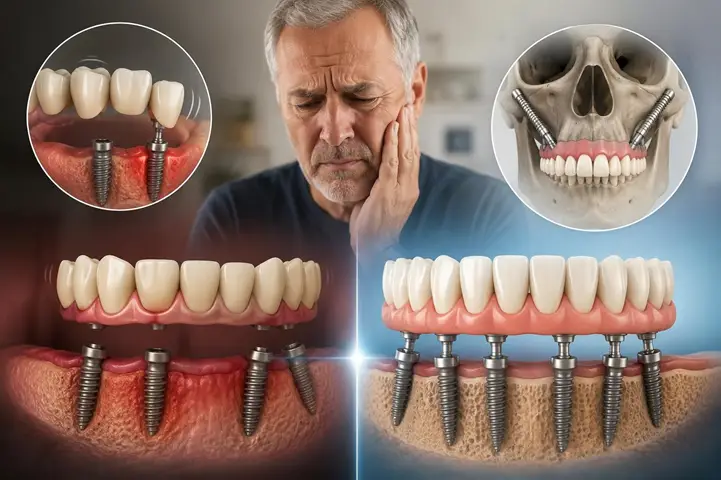
You were promised permanent, fixed teeth in a day. Instead, you’re dealing with a loose bridge, a nagging ache around one implant, or the sinking realization that something’s gone wrong, and now you’re wondering if it can even be fixed.
Here’s the good news: it almost always can. But the fix isn’t always another All-on-4. In many rescue cases, it’s a smarter design (All-on-6) or a completely different implant strategy (Zygoma implants) and understanding the difference could save you another year of pain, uncertainty, and cost.
All-on-4 was designed to be efficient: four implants, one day, a full arch of fixed teeth. It works good, when it’s planned and executed with precision. But when it fails, it’s usually one (or several) of these culprits:
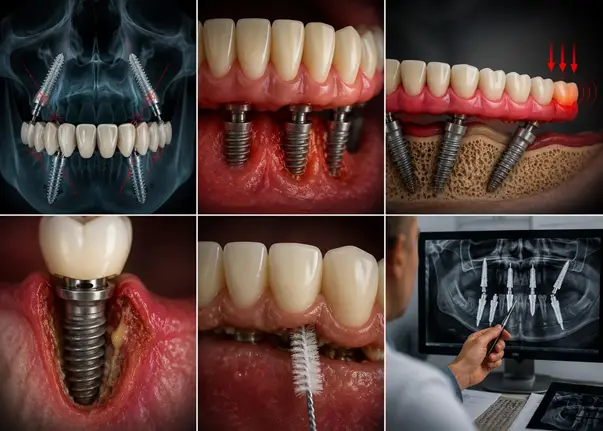
* Poor implant angulation or positioning, placed without a CBCT scan
*Immediate loading on implants that weren’t stable enough to handle it
*Cantilever overload, the back of the bridge extending too far past the last implant, hammering it with every bite
*Peri-implantitis, silent, progressive bone loss around an implant that often isn’t caught until it’s advanced
*Poor hygiene access, a prosthesis design so bulky the patient could never clean around it properly
*Inexperienced planning, full-arch implant dentistry has one of the steepest learning curves in the field, and not every provider has climbed it
None of these are things a patient could have predicted walking in. But they’re exactly what a proper rescue plan has to correct.
Here’s the mechanical truth most patients are never told before their first surgery: All-on-4 asks four implants to do the work that six could share.
Picture the arch as a bridge. All-on-4 places its support beams at just four points, which usually are placed in the anterior segment of the jaw, and teeth extended past the last implant support on either side, towards the back of the mouth. Every time you chew on that unsupported cantilevered section, it acts like a lever, concentrating force on the implants nearest the fulcrum. Over months and years, that repeated overload is one of the most common paths to implant failure.
*All-on-6 solves this at the design level. By distributing six implants evenly across the arch, the cantilever effect is dramatically reduced or eliminated entirely. That means: Biting and chewing forces are spread equally across all implants, instead of punishing two or three of them
*No single implant is a point of failure, if one needs attention, the other five are still sharing the load
*Better performance in variable bone density, since the arch isn’t relying on every implant being flawless
*A more predictable, longer-lasting result, especially for patients who’ve already been through one failed full-arch case
If you’re rebuilding after a failed All-on-4, All-on-6 isn’t just an upgrade, it’s often the correction that fixes the exact flaw that caused the original failure.
Here’s what most patients don’t realize until they’re already in a rescue consultation: when an implant fails, it rarely fails alone, The infection or overload that took down the implant usually damages the bone around it too leaving a compromised, low-density socket instead of clean, healthy bone.
That creates a brutal timeline problem. The conventional rescue path looks like this:
That’s potentially over a year of healing, temporary teeth, and uncertainty for patients who already went through this once.
This is where Zygomatic implant treatment change everything; dental implants without bone grafts
Instead of anchoring into the damaged jawbone, Zygoma implants are anchored into the Zygomatic bone, the cheekbone, one of the densest, most reliable bones in the entire skull. Because they bypass the compromised area completely, they sidestep the biggest obstacle in implant rescue: bone loss.
*Bone grafting can often be skipped entirely, no more months lost waiting for a graft to take
*Immediate implant placement, even in patients with severe bone resorption
*Immediate loading of a fixed prosthesis, many patients leave with functional, permanent teeth in 7 days.
*A dramatically compressed timeline, treatment measured in days, not the year-plus of a graft-dependent rescue
*Strong long-term success rates, even for patients who’ve already experienced implant failure once
For patients staring down a failed All-on-4 with significant bone loss, Zygomatic implants aren’t just an alternative, they’re often the only path to a genuine same-day fixed-teeth solution.
Zygomatic implant surgery is not a procedure every implant dentist performs. It demands advanced 3D imaging, meticulous surgical planning, and serious surgical skill, given the implant’s proximity to the sinus and orbital regions. A failed first attempt at full-arch implants is proof enough that not every provider is equipped for complex cases, choosing the next one matters enormously.
LBR Dental and Implants Center, known for Dental tourism india for implants headed by Dr. K. A. Reddy, is a best Zygomatic implant specialist in india with deep, focused experience in rescuing and rehabilitating failed full-arch implant cases. Dr. K. A. Reddy and the team specialize in taking patients from a failed-implant diagnosis directly to a fixed, immediately loaded prosthesis, without the months of grafting and healing that a conventional rescue demands. If you’re searching for failed All-on-4 treatment, full-arch implant rescue, or a trusted Zygomatic implant specialist near me, LBR Dental and Implants Center is one of the most experienced destinations for advanced full-arch rehabilitation.
A real rescue isn’t a rushed redo. It starts with:
A failed All-on-4 isn’t the end of the road, it’s a chance to get it right. Whether that means moving to a more mechanically sound All-on-6 design, or bypassing damaged bone entirely with Zygomatic implants and walking out with immediately loaded, fixed teeth, the right diagnosis and the right specialist make the difference between another failed attempt and a permanent solution.


Senior Dentist & Full Mouth Rehabilitation Expert