

Dr. K Sharada Reddy, Author
Senior Dentist & Full Mouth Rehabilitation Expert
Pterygoid Implants vs Sinus Lift: Understanding the Options
When a patient is told that there is not enough bone in the upper back jaw for dental implants, the conversation often turns towards a sinus lift. For many years, sinus augmentation followed by bone grafting has been a commonly used approach for patients with reduced bone height in the posterior maxilla. However, it is not the only option available today. Depending on the patient’s anatomy, bone availability,treatment expectations, and the experience of the implant surgeon, pterygoid implants can provide an alternative approach. This is why understanding pterygoid implants vs sinus lift is important before deciding on treatment.
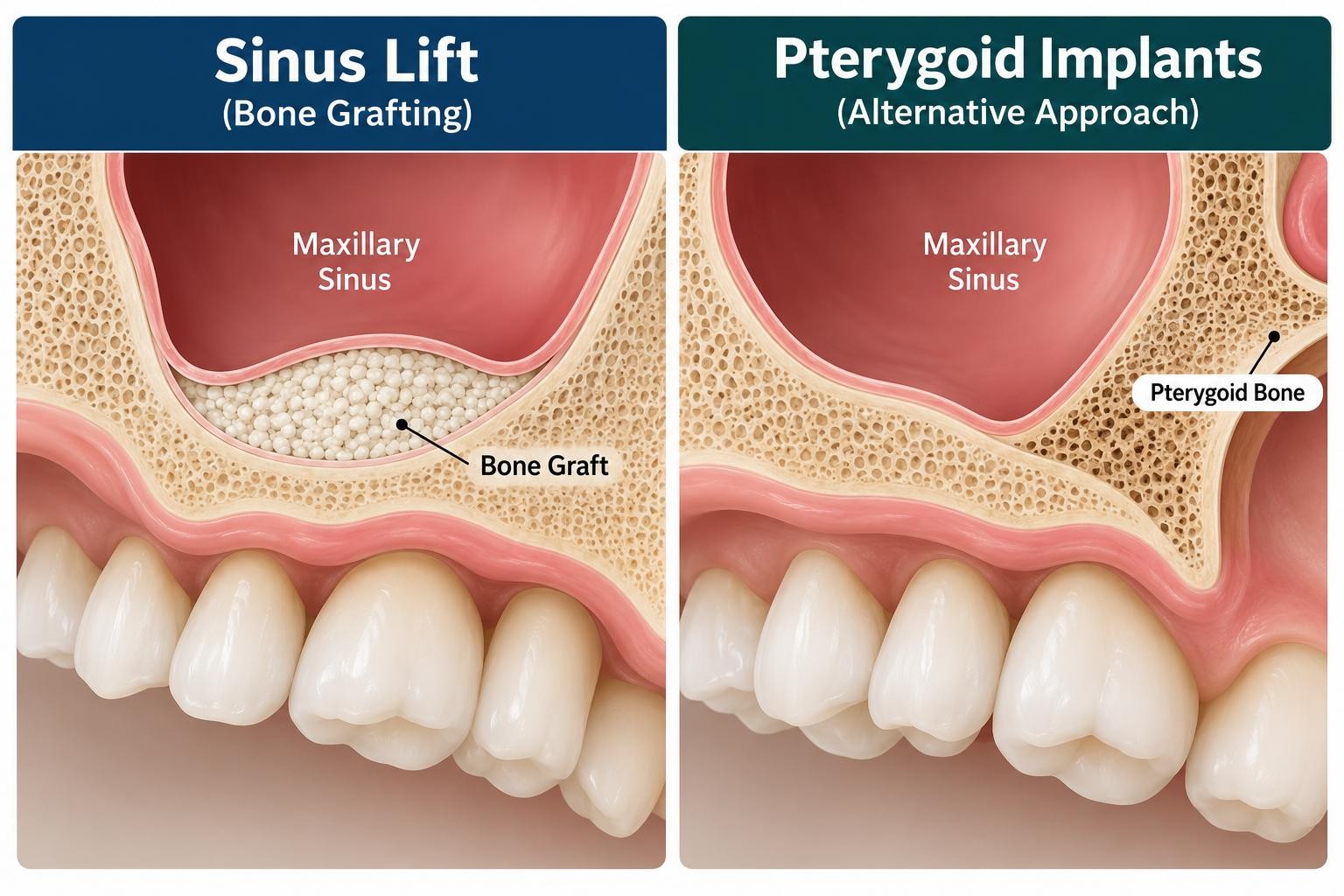
A sinus lift is a surgical procedure designed to create additional bone in the upper posterior jaw. When the natural bone between the oral cavity and the maxillary sinus is too thin to support conventional implants, the sinus membrane is carefully elevated and bone graft material is placed underneath it. The graft then requires time to mature before implants can be placed. For few patients, a sinus lift can be a predictable treatment. However, it adds another surgical procedure, involves grafting,additional expenditure and will extend the overall treatment timeline by several months.
Pterygoid implants take a different approach. Instead of trying to regain the bone that is already lost, by adding bone underneath the maxillary sinus, one can utilize the existing hard bone present behind the upper third molars, where the implant is strategically placed towards the posterior region of the maxilla to engage the dense pterygoid or pterygomaxillary region. This area can provide strong cortical anchorage even when the posterior alveolar bone has undergone significant resorption. In complete upper arch replacement cases or replacement of upper posterior teeth, pterygoid implants are one of the potential sinus lift alternatives for patients who want to avoid grafting and additional sinus surgery.
One of the biggest differences when comparing pterygoid implants vs sinus lift is
the philosophy behind the treatment. A sinus lift attempts to create more bone where bone has been lost. A pterygoid implant, on the other hand, is designed to make use of the bone that is already available in the posterior maxillary region. In simple terms, instead of always asking, “How can we rebuild the missing bone?”, where the patient has to be subjected to additional surgeries and which also delays the treatment, an experienced implant surgeon may also ask, “Where is the strongest bone that we can use?” that aids in immediate functional loading of teeth. This change in thinking can be particularly valuable in severely resorbed upper jaws.
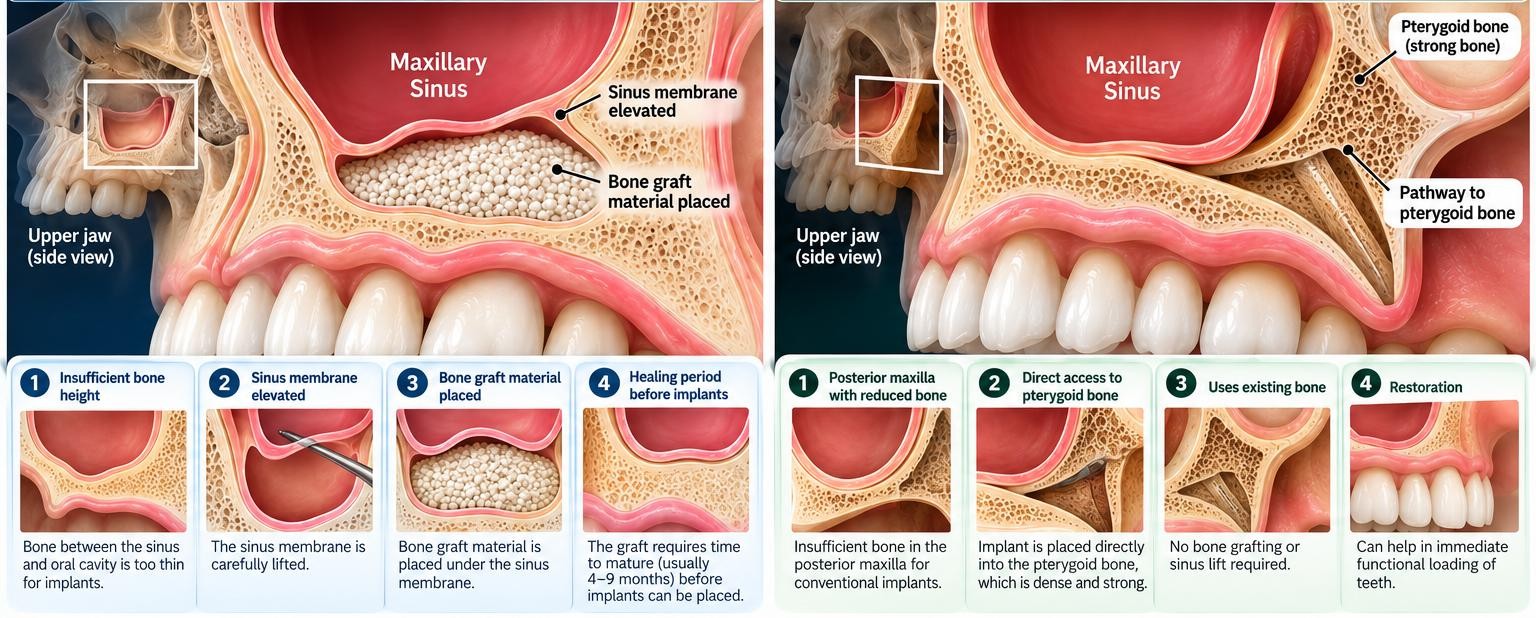
Patients are naturally concerned about treatment time. A conventional sinus lift with grafting may require a healing period before implants can be loaded, depending on the amount of grafting performed and the individual clinical situation. Pterygoid implants can potentially reduce the number of surgical stages and also help fix functional permanent teeth in 7 days. Another reason patients search for implants without sinus lift is the desire to avoid bone grafting. Bone grafting is a valuable procedure when it is indicated, but some patients would prefer a treatment plan that does not require graft material or a separate sinus procedure. This is where pterygoid implants
can be considered in suitable cases.There is also an important distinction between avoiding a sinus lift and simply placing an implant wherever bone happens to be present.
Pterygoid implant placement is a technique-sensitive procedure. The surgeon needs a detailed understanding of the posterior maxillary anatomy, implant angulation, available cortical bone, implant dimensions, prosthetic requirements, and the relationship of the implant to important anatomical structures. The final treatment should be planned prosthetically as well as surgically. A pterygoid implant is not merely a “long implant”; its success depends on correct positioning, appropriate implant selection, primary stability, and a carefully designed prosthesis.
For patients with severe bone loss,where the posterior maxilla has extremely limited bone, other advanced options such as tilted implants, Zygomatic implants, or combinations of different implant strategies may need to be considered. There is no single technique that is best for every patient. The objective should always be to select the least invasive and most predictable solution that matches the patient’s individual anatomy.
When discussing sinus lift alternatives, it is also important to look beyond the surgical procedure and consider the final teeth. The implant position should support a stable, functional, and hygienic prosthesis. In full-mouth rehabilitation, the posterior anchorage provided by pterygoid implants can be particularly useful because it may help reduce the need for excessive distal cantilevers. This can be important when designing a fixed full-arch prosthesis for a patient with extensive bone loss.
Patients often ask, “Is a pterygoid implant better than a sinus lift?” The honest answer is that neither treatment is universally better. A sinus lift may be an excellent choice for single tooth replacements in the upper molar area,when adequate treatment time is available and creating additional posterior bone is appropriate. Pterygoid implants may be advantageous for complete upper jaw teeth replacement or only the grinding teeth in the upper arch,when the available anatomy allows the surgeon to obtain reliable anchorage without grafting or sinus augmentation. The right decision depends on the individual CBCT scan rather than on a comparison made in isolation.
At LBR Dental & Implant Center, Hyderabad, advanced implant treatment is planned around the patient’s existing bone rather than automatically assuming that missing bone must first be rebuilt. Dr. K. A. Reddy, MDS (OSM), FICOI (USA), has a special focus on complex implant rehabilitation, including pterygoid and zygomatic implant solutions. Through the CPBCCI Protocol™, the treatment philosophy emphasizes the strategic use of available cortical bone and conventional implants in appropriately selected cases.
For an international patient, this approach can be particularly relevant. Patients travelling from countries such as the USA, UK, Australia, and Canada often want to understand whether their treatment can be completed without multiple surgical visits and prolonged healing periods. Depending on the clinical situation, advanced implant techniques may provide options for implants without sinus lift, allowing the treatment plan to be more streamlined. Nevertheless, every case must be evaluated individually, and a CBCT scan is essential before confirming the treatment approach.
Ultimately, the choice between pterygoid implants and a sinus lift should not be made simply on the basis of which procedure sounds easier or faster. It should be based on anatomy, long-term stability, prosthetic requirements, overall health, and the surgeon’s experience with complex implant rehabilitation. For some patients, a sinus lift remains the most appropriate solution. For others, pterygoid implants can offer a way to use the patient’s existing posterior bone and potentially avoid sinus augmentation. The important thing is to understand all the available options before committing to treatment.
If you have been told that you do not have enough bone for conventional implants, pterygoid implants vs sinus lift is a conversation worth having with an experienced implant specialist. In modern implant dentistry, “not enough bone” does not necessarily mean that treatment has to stop. In many cases, the real question is not simply how much bone is missing, but where the available bone is and how intelligently it can be used.
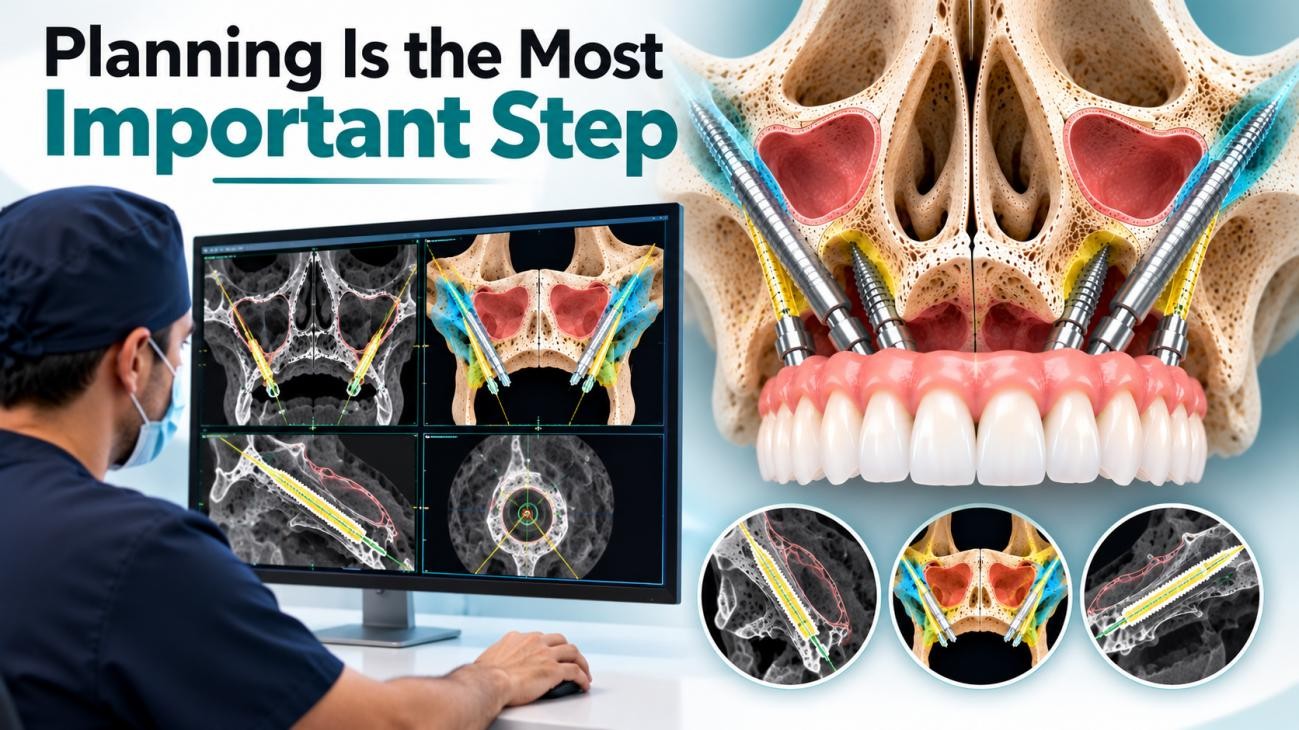
Successful treatment begins long before the surgical procedure. A three-dimensional CBCT evaluation helps the implant surgeon understand the relationship between the maxilla, zygomatic bone, pterygoid region, sinus and other important anatomical
QUICK ENQUIRY
Success Stories

International Patients
Our Clinic

Share this post
Author
Dr. K Sharada Reddy
Senior Dentist & Full Mouth Rehabilitation Expert