
Senior Dentist & Full Mouth Rehabilitation Expert
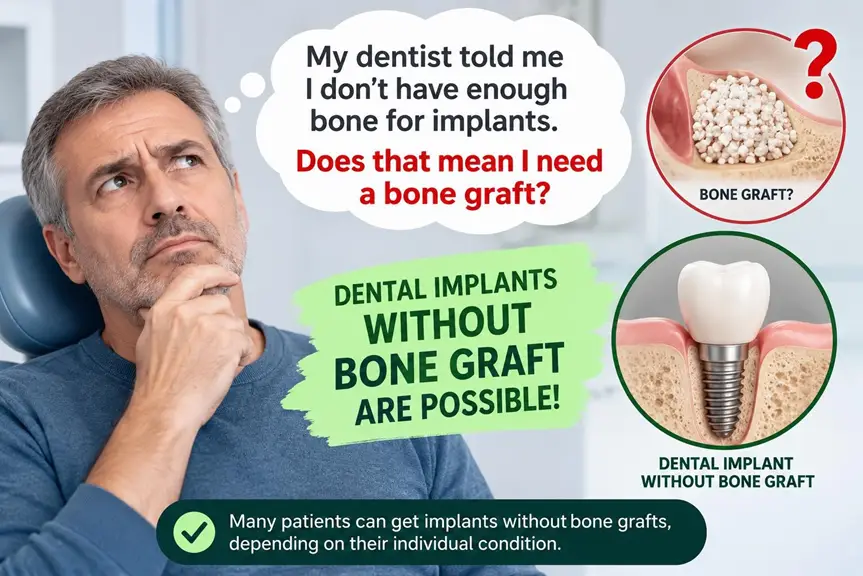
This is one of the most common questions patients ask when they are told that they have significant bone loss. And understandably, the word bone graft can make people nervous. The good news is that dental implants without bone graft procedures are possible for many patients, depending on the amount and location of available bone, the condition of the gums, and the type of implant treatment being planned.
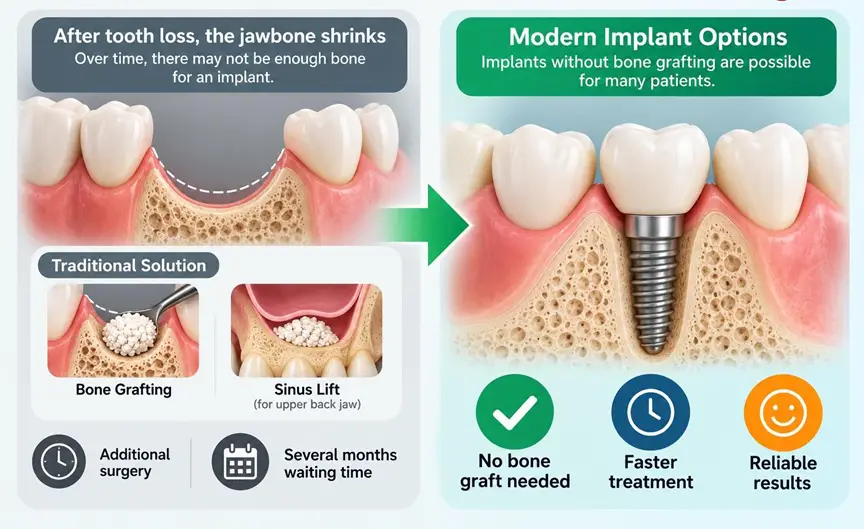
When a tooth is lost, the bone surrounding its roots gradually shrinks because it is no longer being stimulated. After several years, the jawbone may become too narrow or too short for an implant to be placed in the original position.
Traditionally, the solution has been to rebuild the missing bone using a bone graft. In some situations, a sinus lift may also be recommended for implants in the upper back jaw.
Bone grafting can be one of the options to rebuild the lost bone but it involves additional surgical procedures and a waiting period of several months before implants can be actually placed and teeth loaded on them.
Modern implant dentistry gives us additional options for patients who are looking for an immediate and a reliable solution, implants without bone grafting.
A successful implant does not necessarily have to be placed exactly where the natural tooth root once existed. The objective is to find sufficient healthy bone and position the implant in a way that provides good stability and allows the final teeth to function properly.
This is where careful treatment planning becomes extremely important.
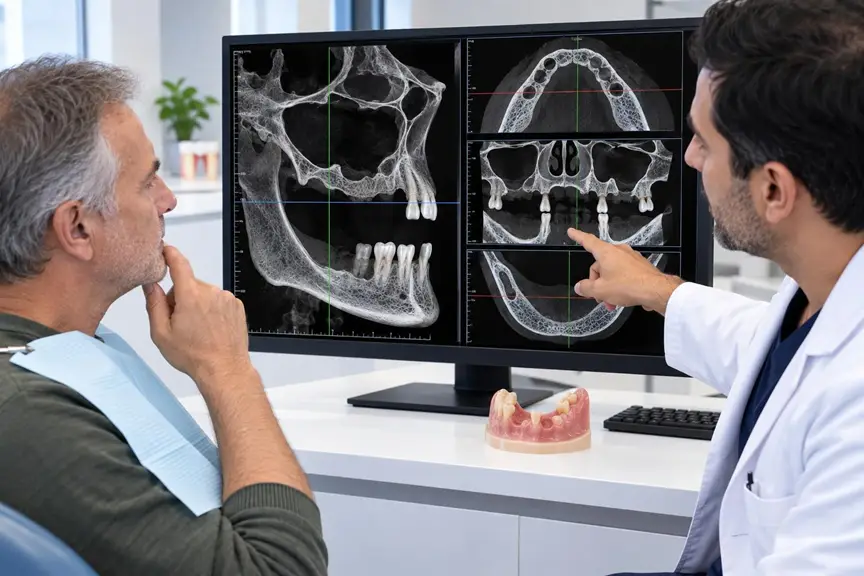
A CBCT scan can show the three-dimensional anatomy of your jaws, including the available bone, sinus position, nerve location, cortical bone and other structures. Instead of simply asking, “Do I have enough bone for an implant?”, your implant dentist should be asking:
That change in perspective can make a significant difference.
The term graftless dental implants generally refers to implant treatment performed without adding bone graft material to rebuild the deficient area.
Depending on the clinical situation, implants may be positioned to engage available native bone, including areas of denser cortical bone. Angled or tilted implants can sometimes be used to take advantage of existing anatomy and avoid structures such as the maxillary sinus.
In patients with severe bone loss, specialised implant solutions may also be considered. These can include pterygoid implants or Zygomatic implants, which use stronger anatomical regions outside the severely resorbed alveolar ridge for implant support.
This does not mean that every patient with bone loss is a candidate for graftless treatment. It means that bone grafting should not automatically be assumed to be the only solution.
When patients hear the words “you have no bone,” it can sound as though dental implants are no longer possible. But even in some of the most extreme cases of jawbone loss, fixed teeth may still be achievable without rebuilding the lost jawbone with bone grafts.
True “no bone” cases do exist. They can occur in patients who have suffered from long-standing infections, have had teeth missing for many years, have worn dentures for prolonged periods, or have experienced severe trauma. In some particularly complex situations, such as patients affected by mucormycosis, large portions of the upper jaw may have to be surgically removed, leaving very little or even no conventional jawbone available for implant placement.
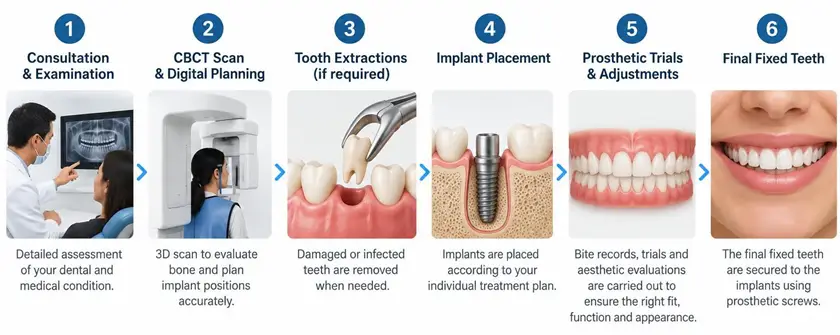
For a full mouth rehabilitation on implants, the treatment journey can be carefully planned and organized so that several important stages are completed during one coordinated visit.
The process usually begins with a detailed consultation and comprehensive diagnostic evaluation. Your dental and medical history, existing teeth, gums, bite, facial aesthetics, and overall oral condition are carefully assessed to determine the most appropriate treatment approach.
A CBCT scan provides detailed three-dimensional information about the jawbone, bone dimensions, and important anatomical structures. This helps the implant team evaluate the available bone and identify suitable implant positions. Based on these findings, the treatment is then digitally planned and surgically coordinated to achieve stability, function, and an appropriate aesthetic outcome.
If the existing teeth are severely damaged, loose, infected, or otherwise beyond predictable restoration, the required tooth extractions can be incorporated into the same treatment plan. The implants are then placed according to the selected implant protocol and the patient’s individual anatomical requirements.
Once the implants have been placed and their stability has been confirmed, the prosthetic phase begins. The required bite records, trials, and prosthetic evaluations are carried out to verify the fit, function, bite, speech, and aesthetics of the new teeth. These steps are important because the goal is not simply to replace missing teeth, but to create a stable and functional full-mouth rehabilitation that is comfortable for the patient.
After the necessary trials and final adjustments are completed, the final fixed teeth are secured to the implants using prosthetic screws. This screw-retained approach allows the restoration to remain firmly attached to the implants while also providing the dental team with the ability to access the prosthesis when required for future maintenance.
The result is that, instead of leaving the clinic with a removable temporary denture, a suitable patient can leave with fixed teeth supported by dental implants. Depending on the individual case, implant stability, bone condition, treatment protocol, and prosthetic requirements, this entire process can be carefully coordinated within a short treatment period.
For international patients, this organized approach can make full mouth rehabilitation more convenient by allowing the diagnosis, implant
placement, prosthetic trials, and delivery of fixed teeth to be planned as one coordinated treatment journey, reducing the need for multiple separate trips while maintaining the necessary clinical checks at every stage.
At LBR Dental & Implant Center, our approach combines clinical implant planning, CBCT imaging, digital scanning, advanced implant techniques and laboratory technology to create a streamlined treatment pathway.
For appropriately selected patients, the treatment can progress from removal of compromised teeth and implant placement to trial teeth, titanium framework fabrication and definitive zirconia teeth within a carefully coordinated workflow.
Every case is individually assessed, and the final treatment timeline depends on the patient’s anatomy, implant stability, oral health, prosthetic requirements and overall clinical condition.
Bone loss is one of the biggest concerns for patients considering immediate loading implants.
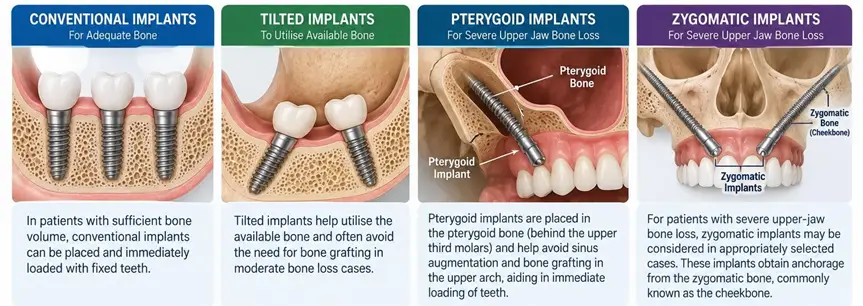
Some patients have adequate bone for conventional implant placement. Others have significant bone loss and may need a more advanced implant strategy.
Depending on the anatomy, options may include strategically positioned conventional implants, tilted implants, Pterygoid implants or Zygomatic implants.
For patients with severe upper-jaw bone loss, Zygomatic implants may be considered in appropriately selected cases. These implants obtain anchorage from the zygomatic bone, commonly known as the cheekbone.
Pterygoid implants placed in the Pterygoid bone present behind the upper third molars on either side help avoid Sinus augmentation and Bone grafting in the upper arch there by aiding in immediate loading of teeth in the upper arch.
Nerve bypass in the lower jaw helps manage implants in highly resorbed lower jaw cases, facilitating immediate loading of teeth.
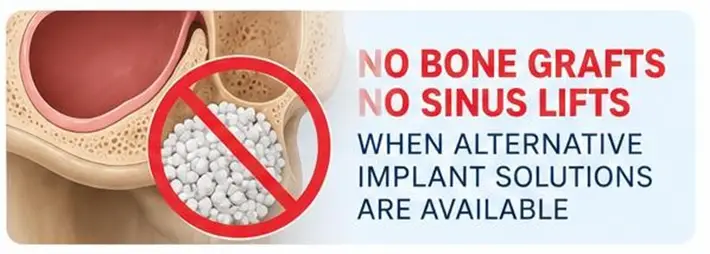
Another common question from international patients is whether they can receive implants without undergoing a bone graft or sinus lift.
Modern implant treatment may allow patients to use available cortical bone or alternative anatomical areas for implant anchorage.
At LBR Dental & Implant Center, treatment planning may include conventional implants as well as advanced approaches such as pterygoid implants and zygomatic implants in the upper arch and Nerve bypass technique in the lower arch for appropriately selected cases.
The objective is to determine what is the best possible approach based on the patient’s anatomy to obtain proper anchorage in the bone so as to fix teeth immediately without subjecting the patient to additional surgical procedures like sinus augmentation and dental bone grafting and delay the treatment by several months.
The possibility of receiving teeth in one week is particularly attractive to patients travelling from overseas.
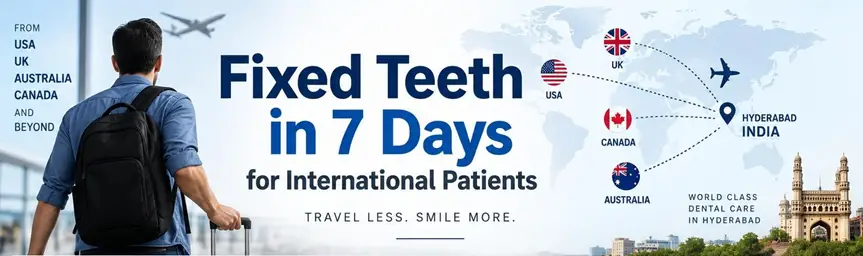
A patient travelling from the USA, UK, Australia, Canada or another country may find it difficult to remain away from home for several months.
A carefully planned immediate-loading treatment can potentially reduce the duration of the initial treatment stay.
Before travelling to India, international patients can often provide their dental history, previous X-rays, photographs and CBCT scans for preliminary assessment where appropriate.
This allows the dental team to understand the case and discuss potential treatment options before the patient arrives.
However, the final decision about implant placement and immediate loading must be made after appropriate clinical evaluation.

At LBR Dental & Implant Center, immediate-loading cases may be treated using the CPBCCI Protocol™ Crestal Polished Bi-Cortical Conventional Implants.
The protocol focuses on achieving primary implant stability through strategic engagement of available cortical bone using conventional two-piece implant systems.
In appropriately selected cases, this approach can form part of an immediate-loading treatment strategy.
The suitability of the protocol depends on the patient’s anatomy, implant stability and prosthetic requirements.
Fixed teeth in 7 days are designed to restore much more than your smile. They are designed to provide good aesthetics, improve self-confidence, and give you the ability to return to eating proper, regular food rather than living on liquids or soft foods for months.
Depending on your individual treatment and healing, you can generally progress to foods such as rice, roti, bread, vegetables and other properly cooked foods, as well as non-vegetarian foods such as soft, well-cooked meat and fish.
Can You Eat Regular Food With Fixed Teeth in 7 Days?
Yes. The objective of immediate fixed teeth is to provide a functional set of teeth that allows you to eat a normal, varied diet while the implants continue their biological healing.
You can immediately enjoy foods such as:Rice and dal,Roti,Bread and other regular cooked foods, vegetables,Eggs,well-cooked chicken and meat and Other foods that are comfortable to chew
What About Hard Foods?
During the early healing period, very hard and excessively crunchy foods should be avoided.
Foods such as almonds, other nuts, hard fruits such as guava, ice, hard candies and very crunchy foods can place excessive biting forces on the healing implants and should not be introduced too early.
Think of it this way:
Regular food — YES.
Very hard food — NOT initially.
When Can You Start Eating Harder Foods?
Harder foods can be introduced gradually as healing progresses, according to your implant stability and your dentist’s clinical assessment.
For many patients, foods such as almonds, nuts and firmer fruits like guava can be slowly reintroduced within the first 3 months, rather than being completely avoided long-term. In suitable cases, the transition toward harder foods can occur well before four months, provided healing is progressing normally and your implant dentist gives you clearance.
The exact timeline varies from patient to patient because bone quality, implant stability, surgical procedure and individual healing all matter.
Fixed Teeth in 7 Days Means Getting Your Life Back
The purpose of fixed teeth in 7 days is not simply to give you teeth that look good. It is to restore aesthetics, confidence, speech and meaningful chewing function within a short treatment period.
You should be able to enjoy the foods that are part of your normal life rice, roti, bread, cooked vegetables, fish, meat and other regular foods while taking sensible precautions during the healing phase.
With proper treatment planning, appropriate dietary progression and regular follow-up, you can gradually move from a protective early diet toward a more complete and unrestricted range of foods.
Fixed teeth in 7 days can give you back your smile, your confidence and the ability to eat proper food while respecting the biology of implant healing.
Are Fixed Teeth in 7 Days Safe?
Yes, fixed teeth in 7 days can be a safe and predictable treatment option for appropriately selected patients when the procedure is properly planned and performed by an experienced implant team.
The concept is based on immediate loading, placing implants and providing fixed teeth within a short treatment period, rather than asking the patient to remain without fixed teeth during the initial healing phase.
The cost of fixed teeth in 7 days depends on the treatment required. Factors can include:
For international patients, the total treatment cost should be discussed before travel, including what is included in the treatment package and what may be charged separately.
Patients should compare complete treatment plans rather than simply comparing the advertised price of an individual implant.
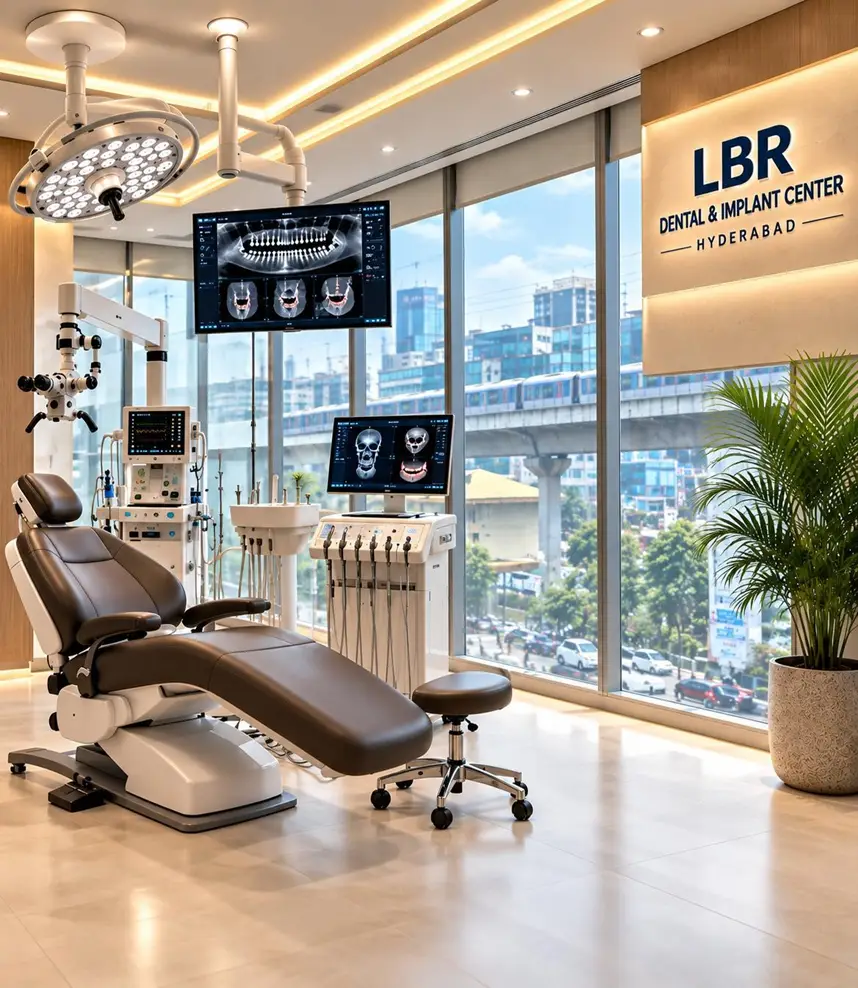
At LBR Dental & Implant Center, Hyderabad, implant dentistry and complex full-mouth rehabilitation are major areas of clinical focus.
Treatment options include full-mouth dental implants, All-on-6, immediate loading, conventional dental implants, Zygomatic implants, quad zygoma, pterygoid implants, implant-supported zirconia restorations and the CPBCCI Protocol™.
The treatment plan is developed according to the patient’s anatomy and clinical requirements.
For international patients, preliminary case assessment can often begin before travel using available dental records and CBCT imaging. This can
help patients understand the likely treatment pathway and plan their visit more effectively.
If you have failing teeth, extensive tooth loss or uncomfortable dentures, you may have more than one treatment option.
Patients with severe bone loss may require advanced approaches such as zygomatic or pterygoid implants.
The important thing is not to choose a treatment simply because it promises the shortest timeline.
Instead, ask:
Is this treatment appropriate for my bone condition? Can adequate implant stability be achieved?
What type of teeth will I receive initially? What happens after the first seven days? What is the plan for my definitive restoration?
These questions will help you make a much more informed decision.
The idea of fixed teeth in 7 days represents one of the major advances in modern implant dentistry. For appropriately selected patients, immediate loading can allow fixed provisional teeth to be provided shortly after implant placement, potentially transforming the treatment experience for people who have been living with missing teeth or uncomfortable dentures.
But the real goal should never be simply to provide teeth within seven days.
The goal is to provide stable, functional and well-planned implant-supported teeth that can serve the patient for the long term.
For international patients, particularly those travelling to India for full-mouth rehabilitation, a shorter treatment pathway can be extremely convenient. But proper diagnosis and patient selection must come first.
At LBR Dental & Implant Center, Hyderabad, patients can be evaluated for conventional and immediate-loading implant solutions, including advanced treatment options for selected cases with significant bone loss.
If you are considering permanent teeth in 7 days, teeth in one week, or immediate loading implants, the first step is a detailed assessment of your teeth, gums, bone and overall treatment requirements.
LBR Dental & Implant Center, Hyderabad
Full Mouth Dental Implants | All-on-6 | Fixed Teeth | Immediate Loading | Zygomatic Implants | Pterygoid Implants | CPBCCI Protocol™
Book an Implant Consultation and Explore Your Treatment Options.


Senior Dentist & Full Mouth Rehabilitation Expert