

Dr. K Sharada Reddy, Author
Senior Dentist & Full Mouth Rehabilitation Expert
The Truth About Permanent Fixed Teeth and Long-Term Oral Health
Are you struggling with loose dentures, difficulty chewing, or hiding your smile due to missing teeth? If you’re searching for the best permanent tooth replacement solution, understanding the real difference between dental implants and dentures can change your life. This guide reveals the truth about fixed teeth, long-term oral health, and why modern implant solutions are transforming smiles.
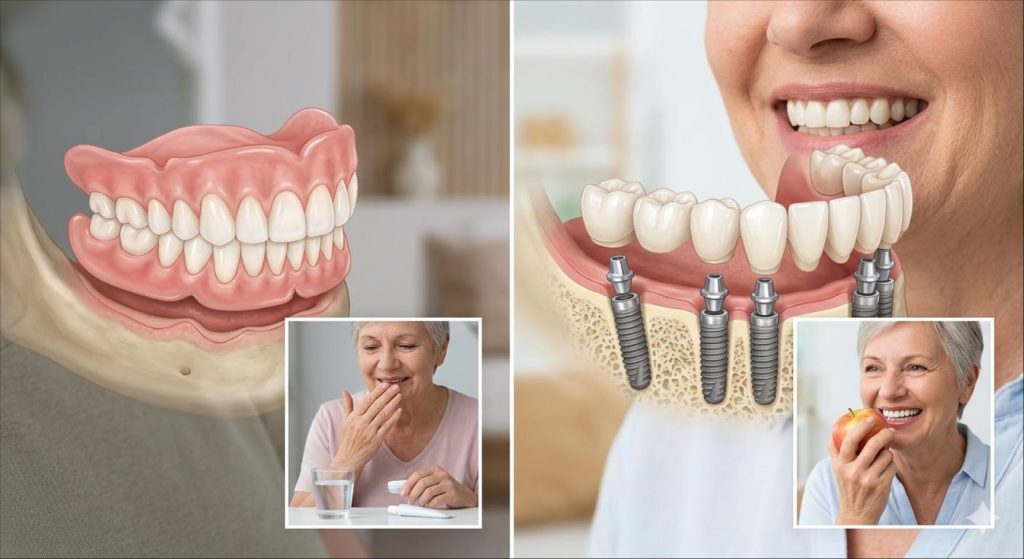
Missing teeth can affect much more than just your smile, they can significantly impact your confidence, eating ability, speech, facial appearance, and overall health. Patients searching for “best solution for missing teeth,” “dentures vs dental implants comparison,” “permanent teeth replacement options,” and “fixed teeth solution near me” are often confused when deciding between dentures and dental implants. While both options are designed to replace missing teeth, they differ greatly in terms of comfort, durability, stability, chewing efficiency, and long-term oral health benefits. Understanding the detailed merits and demerits of each option is essential before making a life-changing decision.
Dentures are a traditional and widely used method for replacing missing teeth. They are removable prosthetic devices that rest on the gums and can replace either a few missing teeth or a complete set. Many patients initially opt for dentures because they appear to be a simple, quick, and economical solution. They are often recommended for individuals searching for “affordable tooth replacement options” or “non-surgical treatment for missing teeth.” One of the main advantages of dentures is their lower initial cost compared to dental implants, making them accessible to a wider group of patients. However, dentures are not always as simple as they seem. In cases where complete dentures are required, teeth need to be removed first, followed by a healing period of approximately 4 to 5 weeks for the bone and soft tissues to settle. After this, a minor surgical procedure known as alveoloplasty is often performed to smoothen sharp bony edges and create a proper foundation for denture placement. The denture fabrication process itself involves multiple steps, including primary and secondary impressions, bite registration, and teeth trial, requiring around 5 to 6 clinical visits before the final denture is delivered. Despite this effort, many patients find the final result less satisfactory in terms of comfort and function.
The upper denture typically includes a plate covering the entire palate to achieve retention, which can affect comfort, while the lower denture is U-shaped to accommodate tongue movement, resulting in reduced stability. Since dentures simply rest on the gums and are not anchored to the bone, they often become loose over time, leading to slipping or wobbling during eating and speaking. This is one of the most common reasons patients search for “why dentures become loose over time.” Dentures also provide limited chewing efficiency, usually around 40 50%compared to natural teeth, forcing patients to avoid hard, sticky, or fibrous foods, which can negatively affect nutrition and quality of life.
Another major concern with dentures is continuous bone loss. When natural teeth are missing, the jawbone no longer receives stimulation, leading to gradual shrinkage. Dentures do not prevent this process; in fact, the constant pressure they exert on the gums may accelerate bone loss. Over time, this results in loosening of the denture, frequent need for replacement (typically every 5 years), and a reduction in facial height, giving the patient a sunken and aged appearance. In severe cases, bone loss may become so extensive that fabricating a stable denture becomes difficult or even impossible. Patients may also experience speech difficulties, especially during the initial adjustment phase, and dentures require regular maintenance, including daily removal, cleaning, relining, and periodic adjustments. Additionally, the fear of dentures slipping in social situations can have a psychological impact, reducing confidence and overall quality of life.
Dental implants, on the other hand, are considered the most advanced and reliable solution for missing teeth and are widely regarded as the gold standard in modern dentistry. Patients searching for “permanent teeth replacement solution,” “fixed teeth vs removable dentures,” and “long lasting dental implants near me” often prefer implants due to their superior benefits. Dental implants are titanium posts placed into the jawbone, acting as artificial tooth roots that support fixed crowns or full mouth prostheses. Unlike dentures, implants are anchored securely into the bone, providing complete stability and eliminating any risk of slipping or movement. This allows patients to eat, speak, and smile with confidence.
One of the most significant advantages of dental implants is their ability to preserve jawbone health. By functioning like natural tooth roots, implants stimulate the bone and prevent bone loss, there by maintaining facial structure and preventing premature aging. They also offer a natural look and feel, closely resembling real teeth in both appearance and function. Implants restore near 100% chewing efficiency, enabling patients to enjoy all types of food without restrictions, which greatly improves nutrition and overall lifestyle. In terms of durability, dental implants are highly long-lasting and can remain functional for 20 years to a lifetime with proper care, making them a cost-effective solution in the long run despite the higher initial investment. Furthermore, implants do not rely on adjacent teeth for support, thereby preserving the health of surrounding natural teeth.
Advanced Edge: CPBCCI Protocol (Game-Changer in Dental Implants)
A major advancement in modern implant dentistry is the CPBCCI protocol (Crestal Polished Bicortical Conventional Implants), which has significantly improved the success and predictability of dental implants, even in challenging cases.
Traditional implants are often placed primarily in the alveolar bone (the softer bone that holds natural teeth). However, this bone is prone to resorption (shrinkage), infection, and failure, especially in patients with:
- Diabetes
- Gum disease
- Severe bone loss
- Long-term missing teeth
The CPBCCI protocol overcomes these limitations by utilizing bicortical anchorage, meaning the implant is stabilized in the strong cortical bone (the dense outer bone), which is more stable and resistant to resorption.
Another key innovation is the dual surface design of the implant:
- Rough surface portion engages with the bone to ensure strong fixation
- Polished crestal portion sits near the gum line, reducing bacterial
adhesion and minimizing the risk of infection or peri-implantitis
This combination is a game changer, as it allows:
- Immediate loading of teeth (fixed teeth within a week)
- Higher success rates even in compromised bone conditions
- Reduced infection risk
- No dependency on bone grafting in many cases
- Better long-term stability and hygiene maintenance
With the CPBCCI protocol, implants can often be placed immediately after tooth removal, under the same anesthesia, followed by digital scanning and prosthetic planning. After required trials such as teeth trial and metal framework trial, permanent fixed teeth are delivered within a week, allowing patients to eat comfortably and regain function almost immediately.
This makes CPBCCI-based implants one of the most advanced solutions for patients searching for:
- immediate loading dental implants
- fixed teeth in 3 to 7 days
- dental implants for diabetic patients
- implants without bone grafting
When comparing dentures and dental implants, it becomes clear that dentures provide a temporary and economical solution, while dental implants especially when performed using advanced protocols like CPBCCI, offer a permanent, stable, and life-enhancing transformation. Dentures may restore basic appearance and function initially, but their long-term limitations often lead patients to seek better alternatives. Dental implants not only replace missing teeth but also address bone health, facial aesthetics, function, and confidence, making them the most advanced and reliable tooth replacement option available today.
In conclusion, choosing between dentures and dental implants is a crucial decision that can significantly impact your daily life. While dentures may appear convenient in the short term, their limitations in stability, comfort, chewing efficiency, and long-term oral health cannot be overlooked. Dental implants, especially with advanced techniques like the CPBCCI protocol, stand out as the most effective, durable, and natural-looking solution for replacing missing teeth. If you are searching for “best permanent teeth replacement,” “fixed teeth solution near me,” or “long lasting dental implants,” understanding these differences will help you make an informed decision that can truly transform your smile and overall quality of life.
Real Patient Transformation: From Struggling with Dentures to Confident Fixed Teeth
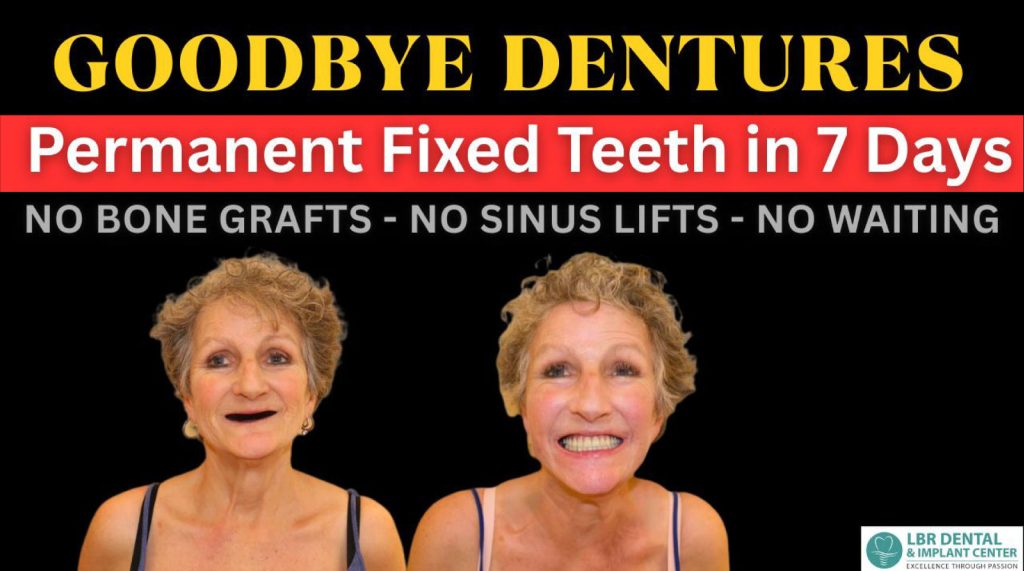
Mrs. Alison Hagger, a 58-year-old patient, came to us with a long history of dental problems and frustration. Like many patients searching for “affordable tooth replacement” and “best dentures for missing teeth,” she had been using complete dentures for several years. Initially, dentures seemed like a convenient and economical solution. However, over time, they began to create more problems than comfort.
Before Treatment: Life with Dentures
Mrs. Alison Hagger faced multiple challenges that significantly affected her daily life. Her dentures had become loose due to continuous jawbone shrinkage, making it difficult for her to eat properly. She avoided her favorite foods like fruits, nuts, and traditional meals because chewing was uncomfortable and unreliable. Speaking in social situations became stressful, as she constantly feared her dentures might slip or move.
she also noticed a gradual change in her facial appearance. Due to ongoing bone loss, her face started to look sunken, making her appear older than her actual age. This not only affected her physical appearance but also her self-confidence. she often avoided smiling and social gatherings, which impacted her overall quality of life. Like many others, she searched for “why dentures become loose,” “permanent solution for missing teeth,” and “fixed teeth options near me” before finally seeking a long-term solution.
Diagnosis & Treatment Planning
On evaluation, it was found that Mrs. Alison Hagger had significant bone loss, a condition where traditional implant approaches might require bone grafting and extended treatment time. However, using the CPBCCI protocol (Crestal Polished Bicortical Conventional Implants), a customized treatment plan was created to utilize the available strong cortical bone, avoiding the need for bone grafting.
After Treatment: Life with Fixed Dental Implants
Mrs. Alison Hagger underwent implant placement using the CPBCCI protocol, where implants were placed strategically into the strong cortical bone and stabilized immediately. The procedure was completed under local anesthesia, and within a week, fixed teeth were delivered.
The transformation was remarkable.
she regained the ability to eat all types of food comfortably, including hard and fibrous items he had avoided for years. Her speech became clear and natural, without any fear of slipping teeth. The fixed teeth felt secure, stable, and almost identical to natural teeth.
Most importantly, her facial structure improved due to proper support, restoring a more youthful appearance. Her confidence returned, and she began smiling freely again. Social interactions became enjoyable rather than stressful.

“For years, I struggled with loose dentures and avoided eating properly. I was always worried about my teeth slipping in public. After getting fixed teeth with implants, my life has completely changed. I can eat anything, smile confidently, and feel like I have my natural teeth back.”
Frequently Asked Questions
CPBCCI (Crestal Polished Bicortical Conventional Implants) Protocol is
an advanced implant technique that anchors implants in strong cortical bone instead of weaker alveolar bone. It also features a polished surface near the gums to reduce infection risk. This makes it more stable, safer, and suitable even for patients with low bone density or medical conditions.
Yes, in many cases CPBCCI implants eliminate the need for bone
grafting because they utilize dense cortical bone for support. This reduces treatment time, cost, and surgical complexity.
Yes, CPBCCI protocol is specifically designed for immediate loading,
allowing fixed teeth to be placed within a week. This is safe and effective when performed by experienced implant specialists.
FDA approved CPBCCI Protocol implants are particularly beneficial for
diabetic patients because the polished surface reduces infection risk and the cortical bone provides stronger support, improving success rates compared to conventional methods.
Conventional implants rely mainly on alveolar bone and often require
healing time before loading. conventional implants placed with the help of CPBCCI Protocol use bicortical anchorage, have a polished crestal design, allow immediate loading, and provide better long-term stability, especially in compromised cases.
QUICK ENQUIRY
Success Stories

International Patients
Our Clinic

Share this post
Author
Dr. K Sharada Reddy
Senior Dentist & Full Mouth Rehabilitation Expert